— Cattle management software · United States
Cattle management software for U.S. cow herds
Swap the pocket calving book and the shoebox of vet receipts for one app. DairyLogs is cattle management software for official ID, calving, breeding, treatments and sale — cow management software for the breeding females, in U.S. dollars, on the phone you already carry.
Free for up to 10 animals — no card required
— Quick answer
How should U.S. cattle producers keep herd records?
U.S. cattle producers should keep one record per animal, keyed to its official or farm ear tag, and log each event on the day it happens: calving, breeding or bull turnout, pregnancy checks, vaccinations, treatments with product, dose, lot and withdrawal, and every purchase or sale. Digital records on a phone are faster to keep than a calving book, easy to search when a buyer or vet asks, and give your tax preparer clean totals at the end of the year.
Key takeaways
- Store the 15-digit 840 EID number, a farm tag or both as the animal's ID.
- Calving book on your phone: dam, sire, date and calf record in one step.
- Treatment records with product, dose, lot, vet and withdrawal date.
- Sales and expenses in dollars, grouped for Schedule F.
Last updated by the Dairy Logs team
— Who asks for what
The cattle records U.S. producers get asked for
Between animal disease traceability, quality assurance programs, buyers and the IRS, every cattle operation has a paper trail to keep. Here is what each usually wants.
| Record | Who asks for it | What to keep | In DairyLogs |
|---|---|---|---|
| Official ID | USDA traceability rules, your vet for interstate health papers | 840 EID tag number, breed, sex, age | Animal profile tag number |
| Treatments | BQA, buyers, packers, your vet | Date, animal, product, dose, lot, route and site, withdrawal | Health records with medicine lots and notes |
| Vaccinations and deworming | Your vet, preconditioned calf sales | Product, date, booster due date | Health → vaccinations and deworming |
| Calving and breeding | Your own culling decisions, bull and heifer buyers | Dam, sire, calving date, breeding dates, preg check | Calving and breeding |
| Purchases and sales | IRS Schedule F, your lender | Date, head, price, buyer or seller | Herd status and finance ledger |
| Feed and medicated feed | Your vet and feed supplier for VFD feeds | What was fed, to which group, and when | Feed records and feed inventory |
Rules change and vary by state. DairyLogs stores your records; it does not file anything with USDA, your state veterinarian or BQA. Check current requirements with your vet or state animal health office.
— The breeding cows
Cow management software for U.S. breeding herds
Cow management software is the record for the females you keep for years. Cattle management software is the wider herd: those cows, plus bulls, steers and calves.
On a U.S. cow-calf or heifer-raising place you need both, because a calf's record starts the day the cow calves. DairyLogs stores the 15-digit 840 number or your farm tag on the cow, logs the calving and the calf together, and keeps product, dose, lot and withdrawal on each treatment. It does not file movement reports with USDA, and it is not a BQA certification. It is the record you can open in the chute when a buyer or a vet asks.
If the cows are milked, that parlor routine is dairy herd management software: milk in the tank, a residue check before the tanker, and dairy cow management software on each cow. The U.S. dairy herd management program is a different day's work from a cow-calf book, so it has its own page.
- Official ID or farm tag on the cow, searchable in the chute.
- Last calving, bull turnout or AI, and the preg-check result on her profile.
- Treatment details a buyer or a BQA-style check usually asks to see.
- The calf stays linked to the dam from the calving event.
— U.S. operations
Operations that run their cattle records on DairyLogs
Custom heifer raisers
The challenge: Heifers belong to several dairies, and each owner wants proof of vaccinations, breedings and preg checks.
With DairyLogs: Run a separate farm per client and invite each dairy with view-only access to its own heifers.
Beef-on-dairy calf raisers
The challenge: Calves arrive in batches from different dairies, and treatment history decides whether a group makes money.
With DairyLogs: Every calf gets a record on arrival, with treatments, costs and sale price tracked to the head.
Cow-calf operations
The challenge: Calving books in several pockets, a breeding season in someone's head and vet receipts in every truck.
With DairyLogs: Calving, bull turnout, preg checks and calf sales recorded on a phone and searchable by tag.
Multi-site operations
The challenge: Several locations, a manager at each, and owners who can only see the whole herd by phoning around.
With DairyLogs: Every location as its own farm under one login, roles for each team, animals transferable between farms and one set of reports.
— The cattle year
A spring-calving cow-calf year in DairyLogs
Timing shifts with region and calving season, but the records follow the same cycle. DairyLogs works from each animal's own dates, so fall-calving herds use the same steps.
Jan – Feb
Pre-calving
Give and record pre-calving vaccines, check hay inventory against the days left until grass, and sort cows by expected calving date.
Feb – Apr
Calving season
Record each calving with dam, sire, date, calving ease notes and the calf's tag. Calf treatments start a health history from day one.
May – Jul
Breeding season
Log AI breedings or bull turnout and removal dates. DairyLogs works out heat and expected calving dates from your settings.
Sep – Oct
Weaning and preg checks
Record weaning, preconditioning vaccines and preg check results. Open cows are flagged so cull decisions are made before winter feeding.
Nov – Dec
Sales and year-end
Record calf and cull cow sales, then pull income and expense totals for Schedule F and next year's budget.
— What you get
Cattle record keeping features U.S. producers use most
- 01
Official and farm IDs
Use the 840 EID number, a farm tag or both as the animal's tag number, plus breed, sex, birth date and status.
How to add an animal - 02
Calving book
Record calvings with dam and sire linked, and the calf's own record created in the same step.
Calving records - 03
Breeding season
AI breedings with semen inventory, natural service dates, preg checks and expected calving dates.
Breeding - 04
Treatment records
Diagnosis, product, dose, medicine lot, vet and withdrawal date for every treatment, with medicine inventory deducted.
How to log treatments - 05
Hay and feed inventory
Hay, silage, grain and mineral on hand, rations fed by group and alerts before you run short.
Feed inventory calculator - 06
Sales and Schedule F
Purchases, sales, feed and vet bills in dollars, with income vs cost and cash flow reports.
Finance
— Inside the app
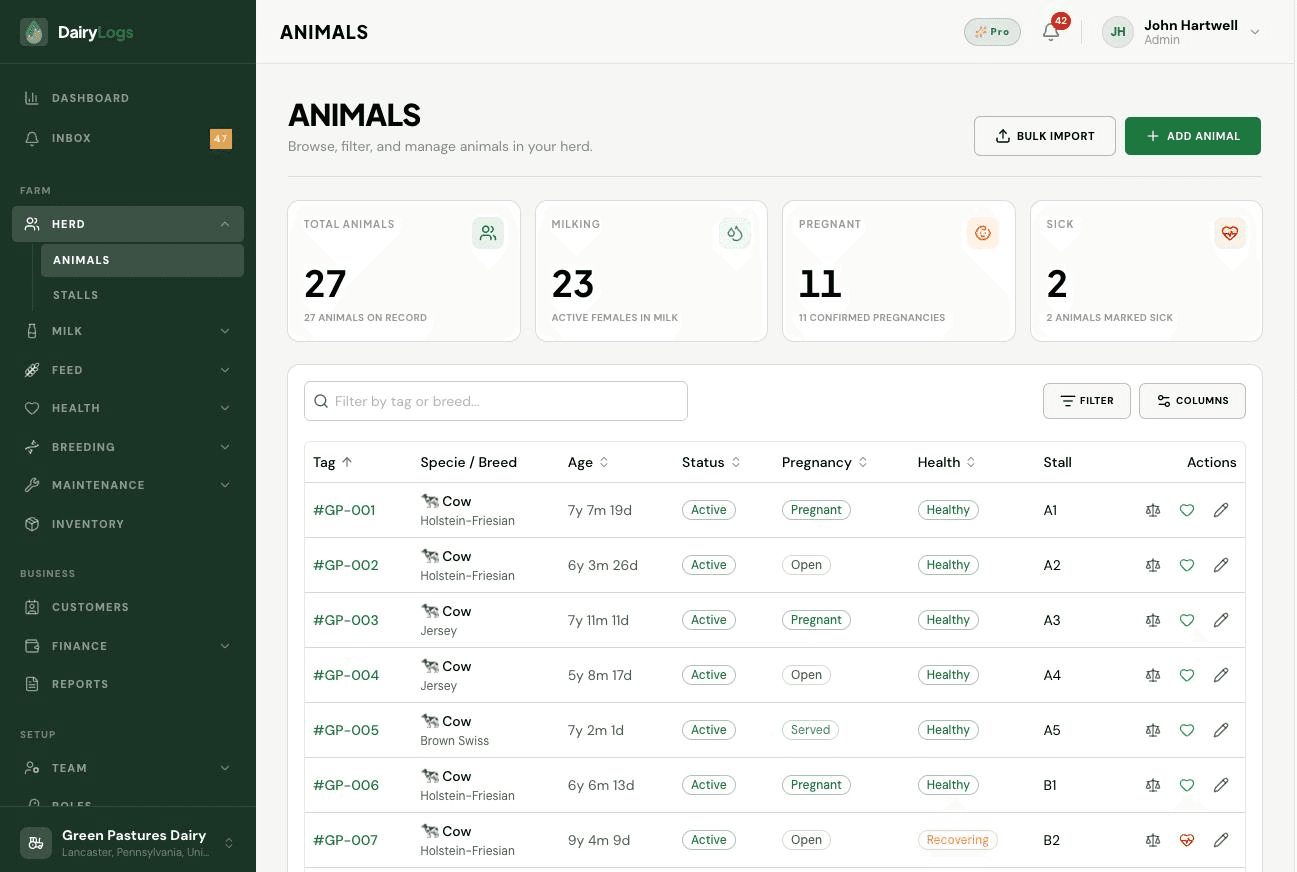
Your whole herd, searchable by tag
- Find any animal by tag number in seconds, from the chute or the truck.
- Filter by status, sex or pregnancy to sort cows for the vet visit.
- Open a profile for the full history: calvings, breedings, treatments and sale.
- Import an existing list from Excel or Google Sheets to get started.
— Buyer's checklist
Six things to check in any cattle management software
Whatever system you choose, check it against these six points. Here is how DairyLogs answers each one.
One record per animal, for life
Every cow, heifer, bull and calf keeps one profile from birth or purchase to sale, with its full history attached.
Breeding and calving on autopilot
Heat, breeding, preg check and calving dates drive reminders automatically, for dairy and beef cows alike.
Treatment records buyers trust
Product, dose, lot, vet and withdrawal date on every treatment, searchable in seconds.
Teams with the right access
5 built-in roles control what each person can see and change, from crew to vet to accountant.
Scales with the operation
Add farms, people and animals as you grow. Custom plans set animal and farm limits to match any operation.
Herd and money in one place
Purchases, sales and costs sit next to the animals that earned or cost them, ready for Schedule F.
— Keep reading
More cattle tools and guides
— FAQ
Questions from U.S. cattle producers
01What is cow management software used for in the U.S.?
It keeps the breeding cows: official or farm tag, calving, breeding, pregnancy, and treatments with product, dose, lot and withdrawal. That is the record a buyer, a vet or a BQA-style check asks for. Bulls, steers and calves stay on the same cattle management software herd list.
02Can I use 840 EID tag numbers as animal IDs?
Yes. The tag number field holds up to 50 characters, so a 15-digit 840 number fits, or you can use your farm tag and keep the 840 number in the notes. DairyLogs does not report movements to USDA or your state.
03Does DairyLogs keep BQA-style treatment records?
It keeps the details BQA asks producers to record — date, animal, product, dose, lot, who treated and the withdrawal date — and you can add route and injection site in the notes. DairyLogs is not a BQA certification program.
04How much does cattle management software cost?
Start free with up to 10 head and no time limit. Paid plans run from $10 a month for 50 head to $40 a month for 500, and Custom plans cover operations of any size.
05Does it track weaning weights and average daily gain?
Partly. You can log an animal's weight in kilograms, but there are no weaning-weight or average daily gain reports yet, and scales do not connect directly.
06Can a custom heifer raiser share records with the dairy?
Yes. Keep each client's heifers on their own farm in DairyLogs and invite the dairy with a view-only role, so they see vaccinations, breedings and preg checks without a weekly spreadsheet.
07Can DairyLogs manage thousands of head across several locations?
Yes. Each location runs as its own farm under one login, animals can be transferred between farms with their history, and Custom plans set animal and farm limits to match the operation.
Retire the pocket calving book
Start free with up to 10 head, keep every tag, calving and treatment on your phone, and have year-end totals ready for your tax preparer.