— Dairy herd management software · United States
Dairy herd management software for U.S. farms of every size
Margins are thin, help is hard to find and every tanker load is screened for residues. DairyLogs is dairy management software for U.S. dairies of any size: reproduction, fresh cows, treatments, TMR, teams and the books, in dollars, with no install.
Free for up to 10 animals — no card required
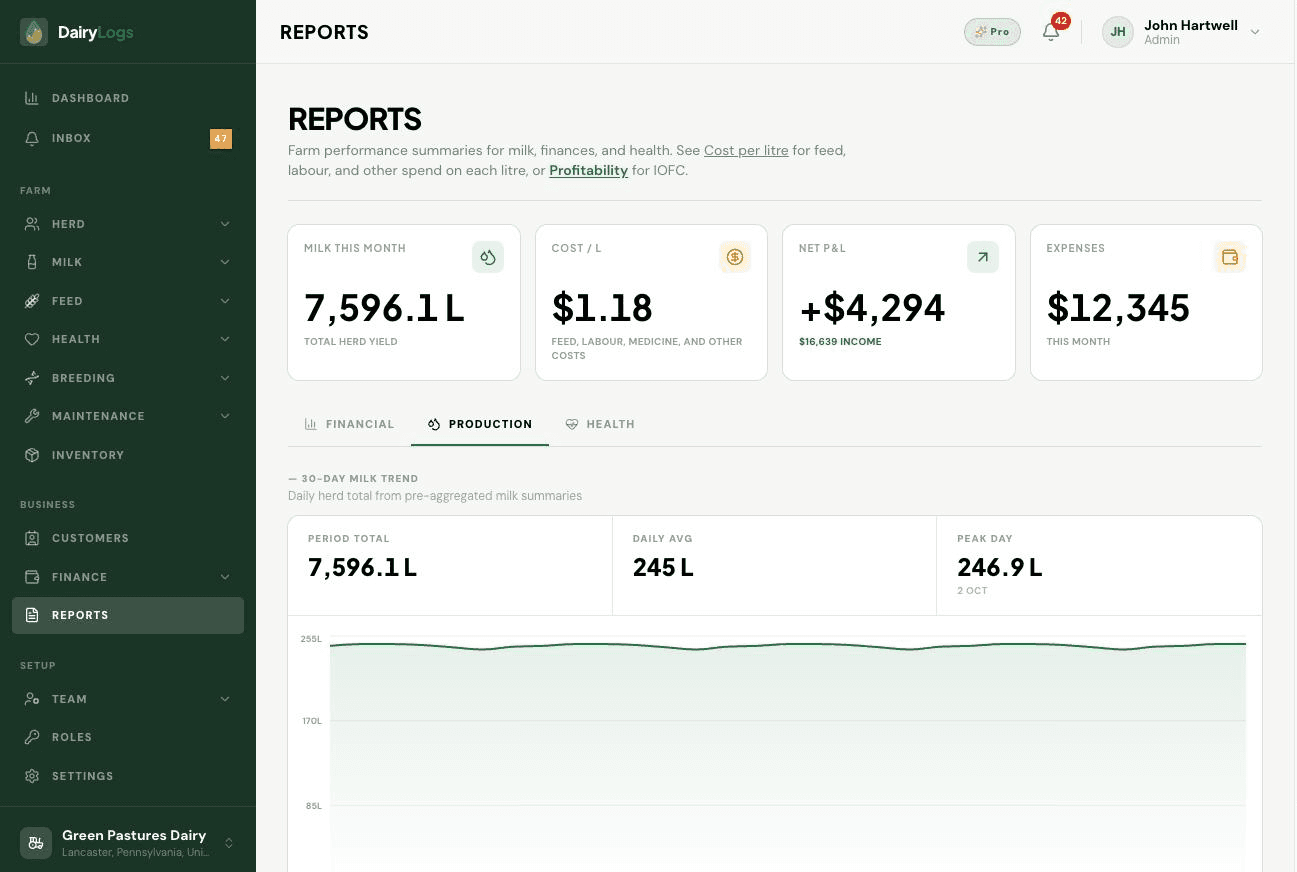
Production report
— Quick answer
What dairy management software do U.S. dairy farms use?
U.S. dairies need herd software that tracks heats, breedings, preg checks and calvings, flags cows on drug withdrawal before they reach the tank, records TMR feeding, lets everyone on the team record from a phone and connects milk to costs for tax time. DairyLogs does all of this in one platform and scales from one barn to multi-farm operations, with custom animal and farm limits for the largest herds.
Key takeaways
- Reproduction on autopilot: 40-day voluntary waiting period, 21-day heat reminders and days-open alerts at 120 days by default — all editable.
- Residue avoidance: every treatment carries a milk withdrawal date, and treated cows are flagged until they're clear.
- Beef-on-dairy ready: track beef and dairy semen straws by sire, breed and cost per straw.
- Books that match the barn: income, expenses and cost per unit of milk in U.S. dollars, ready for your Schedule F.
Last updated by the Dairy Logs team
— The U.S. dairy today
One system from the parlor to the office, at any scale
U.S. dairying keeps consolidating. Herds get bigger, there are fewer hands to run them, and the farms that stay in business are the ones that know their numbers. Too often those numbers are split across a barn whiteboard, a breeding calendar, a separate herd program and the accounting software — and nobody sees the whole picture.
DairyLogs puts it in one place. It runs in a phone browser, so the person treating a cow or catching a heat records it on the spot, and roles control what each milker, herdsman, vet or accountant can see. Several farms sit under one login, with animals transferable between them. And because it connects herd events to money, the same records that tell you which cows to breed also tell you whether each dairy made money last month.
- Conventional, organic and grazing dairies, freestall or tie-stall, 2x or 3x milking.
- Multi-site operations: several farms under one login, with team roles on each farm.
- Heifer-raising operations and dairies with buffalo, goats or sheep alongside cows.
— The U.S. routine
What a U.S. dairy herd management program keeps on schedule
On a U.S. dairy, a dairy herd management program is the routine the team repeats: fresh-cow care, breeding after the voluntary waiting period, a residue check before the tanker, and a decision about which cows get beef semen.
Dairy cow management software is the per-cow record those jobs write to — her lactation, her last breeding, and whether her milk is clear. Dairy herd management software is the work list built from those records, so a new milker can follow the routine without the whiteboard. DairyLogs leaves DHIA testing in place for components, somatic cell count and genetic evaluations, and records what happens between test days.
Breeding females you are not milking — a beef cow-calf herd or custom-raised heifers — are a cow management software job, with official ID and treatment history rather than a parlor routine.
- A fresh cow's treatment and her withdrawal end date are on her profile before the next milking.
- Cows past the 40-day voluntary waiting period, and cows open past 120 days, show up on their own. Both limits are editable.
- Each breeding records dairy or beef semen, so the beef-on-dairy plan is a straw count, not a memory.
— Off the whiteboard
Six jobs DairyLogs takes off the barn whiteboard
- 01
Reproduction
Heats, AI breedings, preg checks, synch programs such as Ovsynch, and calving dates — with reminders when cows pass the voluntary waiting period or run too many days open.
Breeding features - 02
Fresh cows and treatments
Log mastitis, metritis, ketosis or milk fever treatments with drug, dose and withdrawal period. Medicine inventory drops as you use it.
Health records - 03
Drug residue avoidance
Every treated cow shows her milk withdrawal end date, so nobody milks her into the tank by mistake.
How to track milk withdrawal - 04
TMR and feed inventory
Save your TMR as a feed recipe, feed it by group and watch silage, haylage, grain and byproduct inventory count down.
How to create feed recipes - 05
Milk by cow and by milking
Record 2x or 3x milkings per cow, or one bulk tank figure. Spot cows that fall off their lactation curve early.
Milk recording - 06
Farm finances
Milk checks, cull cow and calf sales, feed bills, vet bills and payroll in one ledger, with income over feed cost and cash flow reports.
Finance
— Where the money is
Reproduction records that keep cows on schedule
Every extra day open costs a dairy money in lost milk and later calvings. DairyLogs makes the next reproductive event for every cow impossible to miss.
- Cows past the voluntary waiting period and not yet bred appear on the task list.
- Each breeding records the sire, straw and technician notes, and predicts the next heat.
- Preg check results update the expected calving and dry-off dates automatically.
- Open cows past your days-open limit are flagged for a vet check or a cull decision.
— Breeding strategy
Beef-on-dairy: know which cows got which straws
Many U.S. dairies now breed their best genetics to dairy semen — often sexed — and the rest to beef sires, because crossbred calves are worth more than straight dairy bull calves.
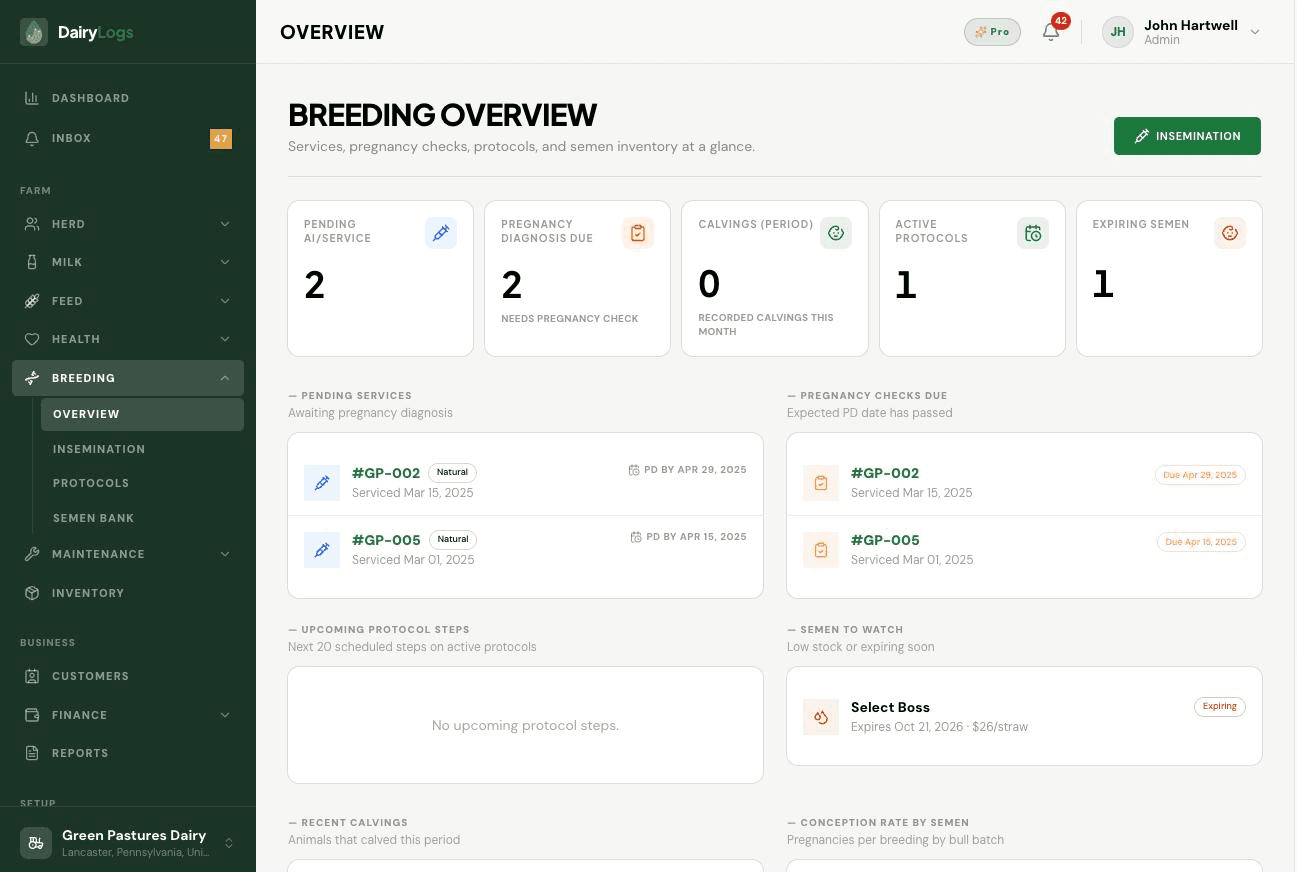
That strategy only pays if the records are right. You need to know which cows were bred to which sire, how many straws of each you have left, what each straw cost, and which calves are crossbreds when they are sold. In DairyLogs the semen inventory holds every straw with bull name, breed, company, batch and cost per straw. Each breeding pulls a straw from inventory and links the sire to the cow, and the calf born from that breeding carries the sire on its record.
When calves are sold, record the sale against the calf and the income lands in the farm ledger. Over a season you can see what your beef-on-dairy program actually earned compared with what the semen cost.
- Semen inventory by bull, breed, company and cost per straw.
- Straws deducted automatically as breedings are recorded.
- Sire linked to every calf for crossbred calf sales.
— Plain-English glossary
U.S. dairy record terms, and how DairyLogs handles them
Herd software is full of abbreviations. Here is what the common ones mean and where DairyLogs stands on each.
- DIM (days in milk)
- Days since a cow last calved. DairyLogs stores each cow's last calving date, and its breeding tasks count days since calving from it.
- VWP (voluntary waiting period)
- Days after calving before a cow is eligible to breed. DairyLogs defaults to 40 days for cattle; change it in farm settings.
- Days open
- Days from calving to conception. DairyLogs alerts you when a cow passes your limit, 120 days by default.
- 21-day pregnancy rate
- The share of eligible cows that get pregnant in each 21-day window. DairyLogs keeps the heat, breeding and preg check records it is built from; it does not calculate the rate yet.
- DHIA test
- Monthly Dairy Herd Improvement testing for components and somatic cell count. Keep testing with your DHIA; DairyLogs is for the daily records between tests.
- SCC (somatic cell count)
- A measure of udder health and milk quality. Record clinical mastitis treatments in DairyLogs; bulk tank and DHIA SCC stay with your co-op and tester.
- cwt (hundredweight)
- 100 lb of milk, the unit most U.S. milk checks are priced in. DairyLogs records milk in liters and income in dollars, so record the milk check total as income.
- IOFC (income over feed cost)
- Milk income minus feed cost — the quickest profit check on a dairy. DairyLogs reports it from your milk, sales and feed records.
- TMR (total mixed ration)
- Forages, grain and minerals mixed and fed together. Save each TMR as a feed recipe in DairyLogs and feed it to groups.
- Schedule F
- The IRS form for farm profit or loss. DairyLogs income and expense records give your tax preparer the totals by category.
— Pricing in USD
What dairy management software costs for your herd size
Published prices, no sales call needed. Pick the plan that matches your milking and dry cows plus the heifers you raise.
Free
Up to 10 animals
$0
No card required
Best for: Trying DairyLogs on your first animals before importing the whole herd.
Starter
Up to 50 animals
$10 / month
or $100 billed yearly
Best for: Herds of up to 50 animals on one farm.
Pro
Up to 250 animals
$25 / month
or $250 billed yearly
Best for: Herds of up to 250 animals across multiple farms.
Business
Up to 500 animals
$40 / month
or $400 billed yearly
Best for: Up to 500 animals across multiple farms, with priority support.
Custom
Any herd size
Custom
Tailored to your operation
Best for: Any herd size: custom animal and farm limits, multi-farm groups and tailored pricing.
Yearly billing gives two months free on Starter, Pro and Business. Compare all plans →
— Keep reading
More for U.S. dairy farmers
— FAQ
Questions from U.S. dairy farmers
01What belongs in a U.S. dairy herd management program?
The daily program is fresh-cow care, breeding after the voluntary waiting period, a residue check before milk reaches the tank, and a record of which cows were bred to dairy or beef semen. DairyLogs stores those events on each cow and lists what is due. Keep DHIA for components, somatic cell count and genetic evaluations.
02How much does dairy management software cost?
DairyLogs publishes its prices: free for up to 10 animals, $10 a month for up to 50 animals, $25 a month for up to 250 animals, $40 a month for up to 500 animals, and Custom plans with animal and farm limits set to match any operation.
03Is DairyLogs an alternative to DairyComp 305?
Yes. DairyLogs covers reproduction, health, feed, inventory, finances, multi-farm management and team roles in one phone-friendly platform, with no install and published pricing. Herds of any size can import their animals from a spreadsheet and start recording the same day.
04Does DairyLogs replace DHIA testing?
No. Keep DHIA testing for components, somatic cell counts and genetic evaluations. DairyLogs records the day-to-day events between tests — heats, breedings, treatments, calvings, feeding and money.
05Can DairyLogs record milk in pounds?
Not yet. Milk is recorded in liters and weights in kilograms. One liter of milk weighs about 2.27 lb, and your milk check can be recorded as income in dollars.
06Does it handle 3x milking?
Yes. Cattle default to three milking sessions a day, and you can switch to two or one in farm settings. Record per cow per milking or one total for the day.
07Can my vet and nutritionist see the records?
Yes. Invite them to the farm with a role that fits — for example a vet role for health and breeding records, or a read-only visitor role for reports.
Get the whiteboard into your pocket
Start free with up to 10 cows, add the rest when you're ready, and see tomorrow's breedings, treatments and calvings on your phone tonight.