Made for Aussie dairies
— Dairy herd management software · Australia
Dairy herd management software for Australian dairy farms
Australian dairying runs on pasture, the calving pattern and the milk cheque. DairyLogs is dairy management software that follows that rhythm — a dairy herd management program for joining, PTIC, dry-off and calving, withholding periods on every treatment, and costs in Australian dollars.
Free for up to 10 animals — no card required
— Quick answer
What should Australian dairy farmers look for in herd management software?
Australian dairy farmers should look for herd software that handles a seasonal or split calving pattern, tracks joining, AI and pregnancy testing (PTIC) against a calving date, records treatments with milk withholding periods, and reports costs in Australian dollars per litre. It should run on a phone in the dairy shed, let owners, managers and sharefarmers share the same records, and sit alongside — not replace — herd testing and the NLIS database.
Key takeaways
- Calving-pattern aware: dry-off, springer and calving reminders for each cow based on her joining date.
- Withholding periods (WHP) calculated on every treatment so treated milk stays out of the vat.
- Feed and fodder stock — hay, silage, grain and pellets — with days of cover for dry seasons.
- Cost per litre and income over feed cost in A$, from the same records the team keeps every day.
Last updated by the Dairy Logs team
— Australian conditions
Why Australian dairies need herd software that fits pasture-based farming
Most dairy software was designed for housed, year-round herds in the Northern Hemisphere. Many Australian herds work differently. In Gippsland, south-west Victoria and Tasmania, much of the year is planned around a spring calving block. Northern Victoria, New South Wales, Queensland and Western Australia have more split and year-round herds, often chasing the processor's seasonal incentives. Either way, the calendar decides when you join, when you preg test, when you dry off and when the calf shed fills.
Pasture-based systems also make feed harder to measure. Cows graze, supplements are fed in the shed, and fodder reserves are built when the season allows and drawn down when it does not. Knowing how many days of hay and silage are left, and what supplement costs per litre of milk, matters more in a dry year than any single production record.
Then there is labour. Owners, managers, sharefarmers, relief milkers and backpackers all touch the herd. Records only stay complete when everyone can enter them quickly from the shed, and when the owner can see the picture without ringing around.
— The Australian routine
A dairy herd management program for seasonal and split-calving herds
In Australia the program is the season you plan and the cow you manage inside it. The herd has a joining window. Each cow has her own last calving, her PTIC result and her dry-off date.
If those dates stay in a pocket diary, a missed joining only shows up when the calving block has already slipped. Dairy cow management software holds the single cow: joining date, sire or bull, pregnancy result, withholding period and litres. Dairy herd management software turns that set of cow records into this week's joining list, preg-test list and dry-off list.
Split and year-round herds use the same cow records. The dates are just spread across the year, which is why the program follows each cow instead of a fixed month. Replacement heifers and beef cows kept off the vat are cow management software: tag, joining and treatments, without a milk session to log.
- Joining and PTIC recorded on the cow, not as a season average.
- Withholding periods on lactating and dry-cow treatments, so milk stays out of the vat.
- Calf and heifer records that carry dam and sire through to first joining.
- Fodder on hand and supplement cost per litre when the season turns dry.
— The dairy year
A spring-calving year, managed in DairyLogs
This is a typical spring-calving calendar for a southern Australian herd. Split and autumn-calving herds run the same jobs on different months — DairyLogs works from each cow's own dates, not a fixed season.
Jul – Sep
Calving
Record each calving with calf details, start the fresh cow's lactation, log early calf treatments, and keep birth records for bobby calves.
Oct – Dec
Joining
Log heats and AI services with the sire and straw used, run synchronisation protocols, then switch to bulls. DairyLogs predicts each cow's next heat and calving date.
Jan – Feb
Pregnancy testing
Record PTIC results for every cow and heifer. Empty cows show up immediately, so cull-or-carry-over decisions happen while feed and milk price still give you options.
Mar – Apr
Feed budgeting
Check hay, silage and grain on hand against days of cover before the autumn break. Record purchases so supplement cost per litre stays visible.
May – Jun
Dry-off
Dry-off reminders arrive for each cow based on her expected calving date. Record dry cow treatment and its withholding period, then group the springers.
— Shed to office
From the dairy shed to the farm office
- 01
In the dairy shed
Record litres per cow per milking in a rotary or herringbone, or one vat figure for the day. See each cow's lactation trend on your phone.
Milk recording - 02
Joining and AI
Heats, inseminations, bull matings, semen straw stock and synchronisation programs, all tied to each cow's expected calving date.
Breeding - 03
Animal health
Mastitis, lameness and metabolic treatments, vaccinations and drenching, with withholding periods and a medicine stock list.
Health records - 04
Calf shed
Calves registered at birth with dam and sire linked, plus weaning ages, vaccinations and early treatments for replacement heifers.
Calving - 05
Fodder and supplements
Hay, silage, grain and pellet stock, rations fed in the shed, and feed cost per day so you can plan for a dry season.
Feed management - 06
Farm office
Income, expenses, payables and accounts in A$, plus staff roles and salaries for owners, managers and sharefarmers.
Finance
— Speaks your language
Australian dairy terms and where they live in DairyLogs
DairyLogs is used on dairies around the world, so some screens use international wording. Here is how familiar Australian terms map across.
| Australian term | What it means | Where in DairyLogs |
|---|---|---|
| Joining | The mating period, by AI or bulls | Breeding → heats and insemination |
| PTIC | Pregnancy tested in calf | Breeding → pregnancy check (status: pregnant) |
| Empties | Cows that tested not in calf | Pregnancy status: open |
| Springers | Cows close to calving | Expected calving date and dry list |
| WHP | Withholding period after a treatment | Health → milk withdrawal until date |
| Dry cow therapy | Treatment given at dry-off | Health treatment at dry-off, with WHP |
| Drenching | Worm treatment | Health → deworming |
| Two-tooth, four-tooth | Age by dentition | Animal profile → teeth stage |
| Vat | The bulk milk tank | Milk usage → sold, kept or discarded |
Herd test results (fat, protein and cell count) and ABVs are not recorded in DairyLogs. Keep using your herd test provider for those and use DairyLogs for day-to-day herd management.
— Cost of production
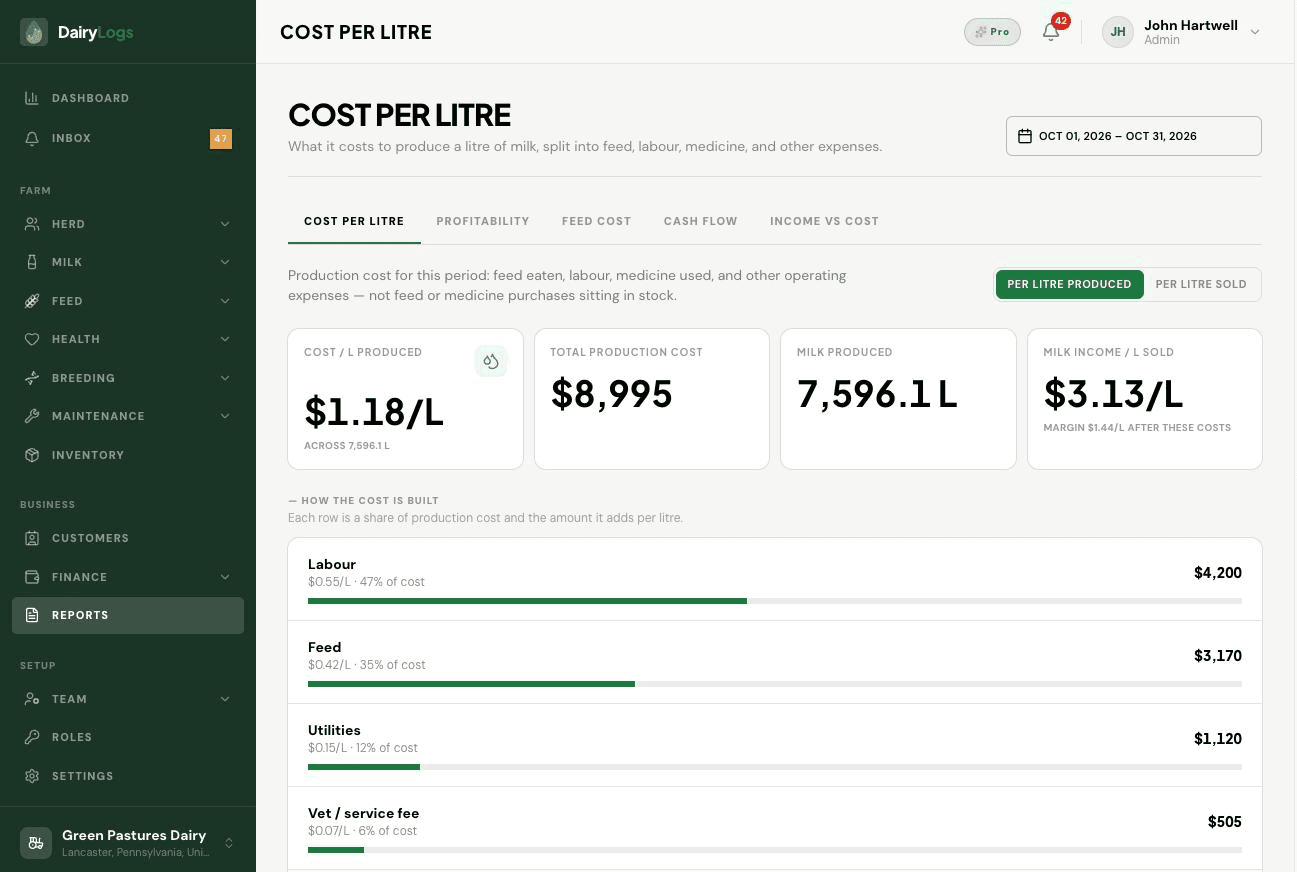
Know your cost of production per litre in A$
When the opening milk price lands, the first question is whether it covers your costs. DairyLogs answers it from the records you are already keeping.
- Set your farm currency to A$ and every expense, sale and report follows.
- See feed cost, total cost and income over feed cost per litre, month by month.
- Compare a wet spring with a dry autumn to see what supplements really cost.
- Bring real numbers to your accountant, bank manager or consultant.
— Before you switch
Choosing dairy herd software in Australia: a checklist
Whether you choose DairyLogs or another system, check these points with your own herd before you commit.
It handles your calving pattern
Seasonal, split or year-round — reminders should come from each cow's own joining and calving dates.
It records in Australian dollars
Expenses, milk income and reports should all be in A$, not converted from another currency.
Withholding periods are automatic
Enter the product and WHP once and the cow is flagged until her milk can go back in the vat.
The whole team can use it
Owner, manager, sharefarmer and relief milkers each need their own login and the right level of access.
It works in the shed on a phone
If it needs a desktop, records get written on a whiteboard and typed up later — or never.
You can see what it costs upfront
DairyLogs is free for up to 10 head, with Starter at $10 (USD) a month for up to 50 animals Pro at $25 (USD) a month for up to 250, and Custom plans for herds of any size.
— Your existing systems
Where DairyLogs fits alongside herd testing, NLIS and your processor
DairyLogs is the day-to-day management layer of the farm. It works alongside the industry systems Australian dairies already rely on and keeps the records they ask for.
Keep herd testing with your herd test centre for components, cell counts and breeding values. Keep recording animal movements in the NLIS database as your state requires — you can store each animal's NLIS tag number as its ID in DairyLogs so records match. Your processor's milk docket remains the official record of what left the vat. What DairyLogs adds is everything in between: the heats, services, treatments, feed, calvings and costs that decide how much milk you send and what it costs to produce.
- Herd test centre: components, SCC, ABVs — keep using it.
- NLIS database: movements and transfers — keep lodging them there.
- Processor: milk dockets and payments — record the income in DairyLogs.
- DairyLogs: daily herd, health, breeding, feed and money records.
— Keep reading
More for Australian dairy farmers
— FAQ
Questions from Australian dairy farmers
01What is a dairy herd management program on an Australian farm?
It is the plan for joining, pregnancy testing, dry-off and calving, run cow by cow rather than as a season average. DairyLogs dates each cow from her own joining and calving, records withholding periods on treatments, and lists who is due this week for a seasonal, split or year-round herd.
02Can I record costs and milk income in Australian dollars?
Yes. Set your farm currency to Australian dollars (A$) in farm settings and all income, expenses and reports use it. Volumes are in litres and weights in kilograms.
03Does DairyLogs work for seasonal and split calving herds?
Yes. Dry-off, heat and calving reminders are calculated from each cow's own joining and calving dates, so a tight spring block, a split spring/autumn herd and a year-round herd all work the same way.
04Does DairyLogs lodge NLIS movements?
No. Movements and transfers still need to be recorded in the NLIS database. You can use each animal's NLIS tag number as its ID in DairyLogs so your management records and NLIS records line up.
05Can owners, managers and sharefarmers share one herd?
Yes. Invite each person to the farm with their own login and give them a role, such as recording milk and treatments only, or full access to finance and reports.
06How are paid plans billed for Australian farms?
Paid plans are listed and billed in US dollars by card; your bank converts the charge to AUD. The free plan covers up to 10 head with no card required, and yearly billing gives two months free.
07Does DairyLogs record herd test components like kg MS?
Not at the moment. DairyLogs records milk in litres per cow or per milking. Fat, protein, kg milk solids and cell counts stay with your herd test provider and processor.
Run your dairy on your own calendar
Start free with up to 10 head, set your currency to A$, and have this season's joining and calving dates working for you today.