Breeds·Nov 17, 2026·DairyLogs Team
How much milk does a Holstein Friesian cow give? Real lactation yields, milk per day by system, 2026 prices and the herd tips that lift yield.
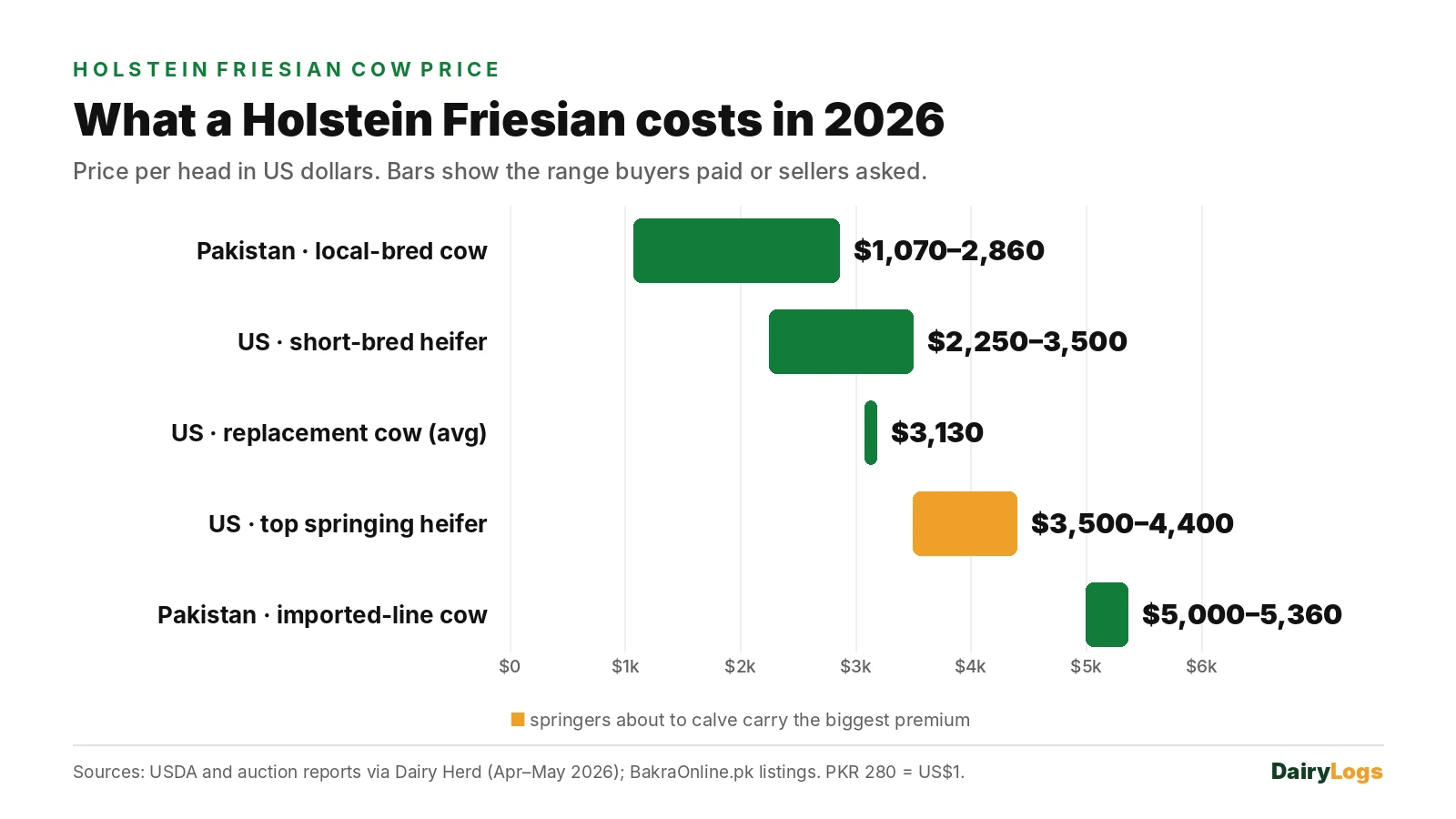
A Holstein Friesian cow produces about 23,000 lb (10,400 kg) of milk in a 305-day lactation, or roughly 33 litres a day on average. Well-fed mature cows peak at 45–55 litres. In 2026, top springing Holstein heifers sold for $3,500–$4,400 at US auctions.
The Holstein Friesian is the highest-volume dairy breed in the world, but it is also the most demanding. Buy one without the feed, cooling and records to support her, and a 40-litre cow quickly becomes a 20-litre cow with a fertility problem.
This guide gives you real milk capacity figures by country, realistic milk per day by production system, 2026 prices in the US and Pakistan, and the management numbers that decide whether a Holstein pays for herself.
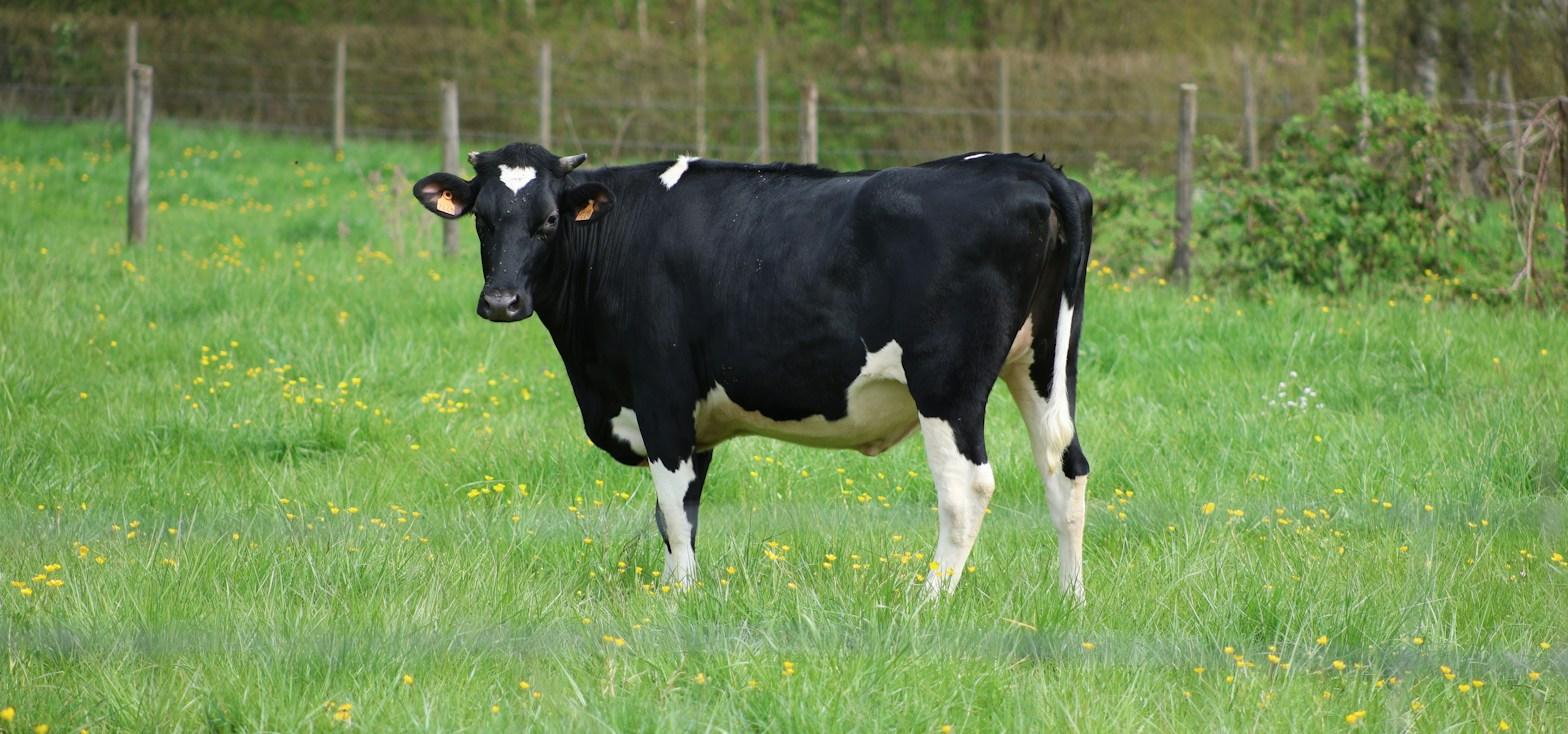
The Holstein Friesian is a large black-and-white (sometimes red-and-white) dairy breed developed over roughly 2,000 years in North Holland and Friesland, in today's Netherlands. Dutch settlers and breeders selected for one trait above all others: milk volume from grass and forage.
Holsteins reached the United States in the 1850s and now make up the vast majority of the US dairy herd. They are the base breed for most commercial dairies in Europe, Australia, Pakistan, India and Latin America, and the Holstein half of crossbreds such as the Girolando cow.
You will see three names used for the same family of cattle. The difference is mostly about which direction breeders pushed the genetics.
Holstein (North American type): taller, more angular, bred hard for milk volume. This is the type behind most high-yield herds and imported semen.
Friesian cow (British, Irish and New Zealand type): smaller and more muscular, with better body condition on grass and more value as a cull or bull calf.
Holstein Friesian: the umbrella name used by most breed societies and in markets like Australia and Pakistan, where herds mix both types.
If you run a pasture system, a Friesian-type cow often holds condition and gets back in calf more easily. In a total mixed ration (TMR) barn, the Holstein type usually wins on litres.
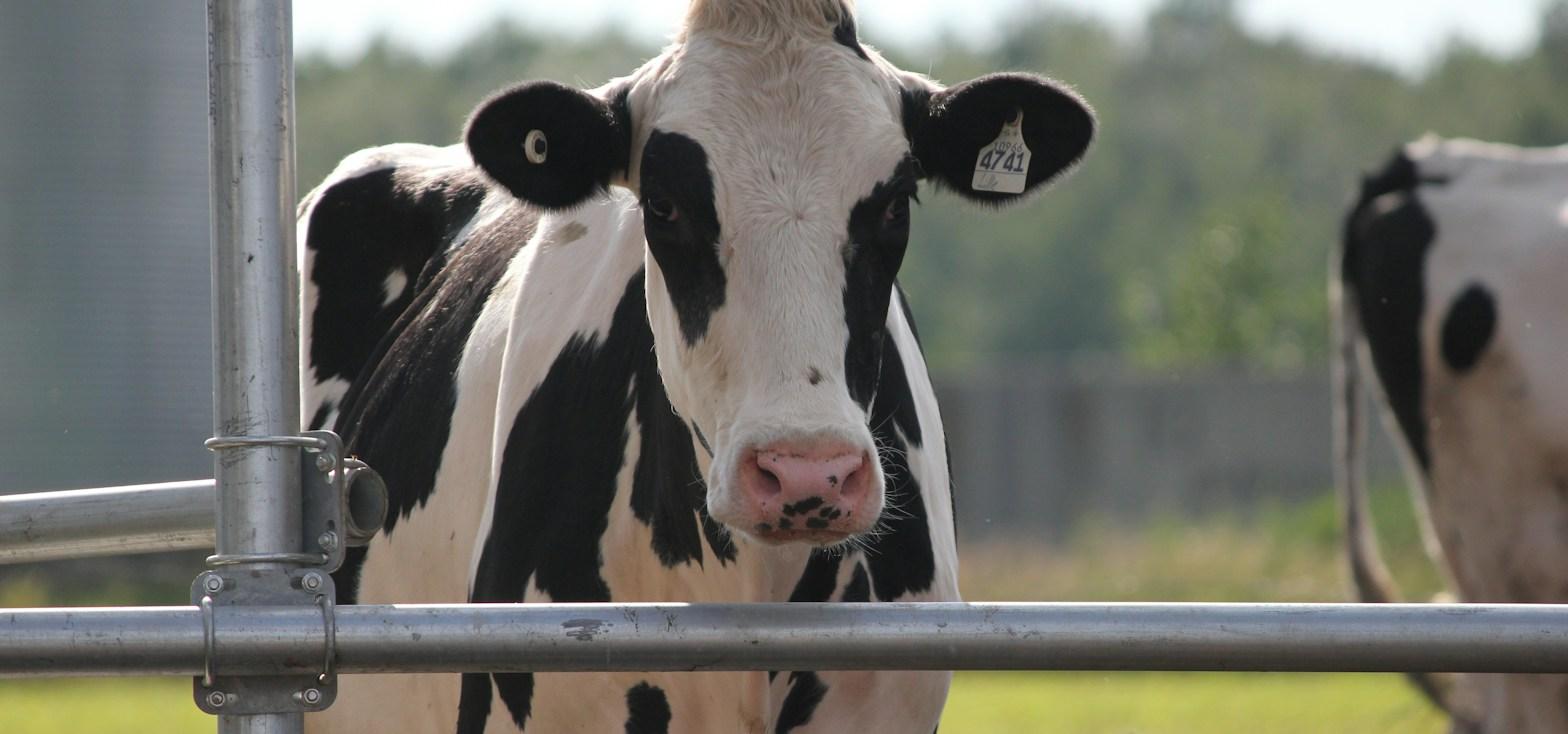
Trait | Typical value |
|---|---|
Origin | North Holland and Friesland (Netherlands) |
Colour | Black and white; red and white in some lines |
Calf birth weight | 36–45 kg (80–100 lb) |
Mature cow weight | About 680 kg (1,500 lb) |
Height at shoulder | About 147 cm (58 in) |
Age at first calving | 23–26 months |
Gestation length | About 280 days (9 months) |
Butterfat / protein | About 4.0% fat / 3.2% protein |
Figures are drawn from Holstein Association USA breed facts, with fat and protein from national milk recording data.
Milk capacity is best measured as total milk in a standard 305-day lactation. Daily figures swing too much with days in milk, season and feed to tell you what a cow is really worth.
Country | Average milk per recorded Holstein (kg) | Fat % | Protein % | Basis |
|---|---|---|---|---|
United States | 12,702 | 4.05 | 3.20 | 305 days (2021) |
Denmark | 11,443 | 4.12 | 3.55 | 365-day rolling |
Canada | 11,253 | 4.08 | 3.32 | 305 days |
Sweden | 11,247 | 4.17 | 3.57 | 365-day rolling |
Estonia | 10,905 | 3.85 | 3.34 | 365 days |
Source: Agriculture and Agri-Food Canada, average production per cow and breed.
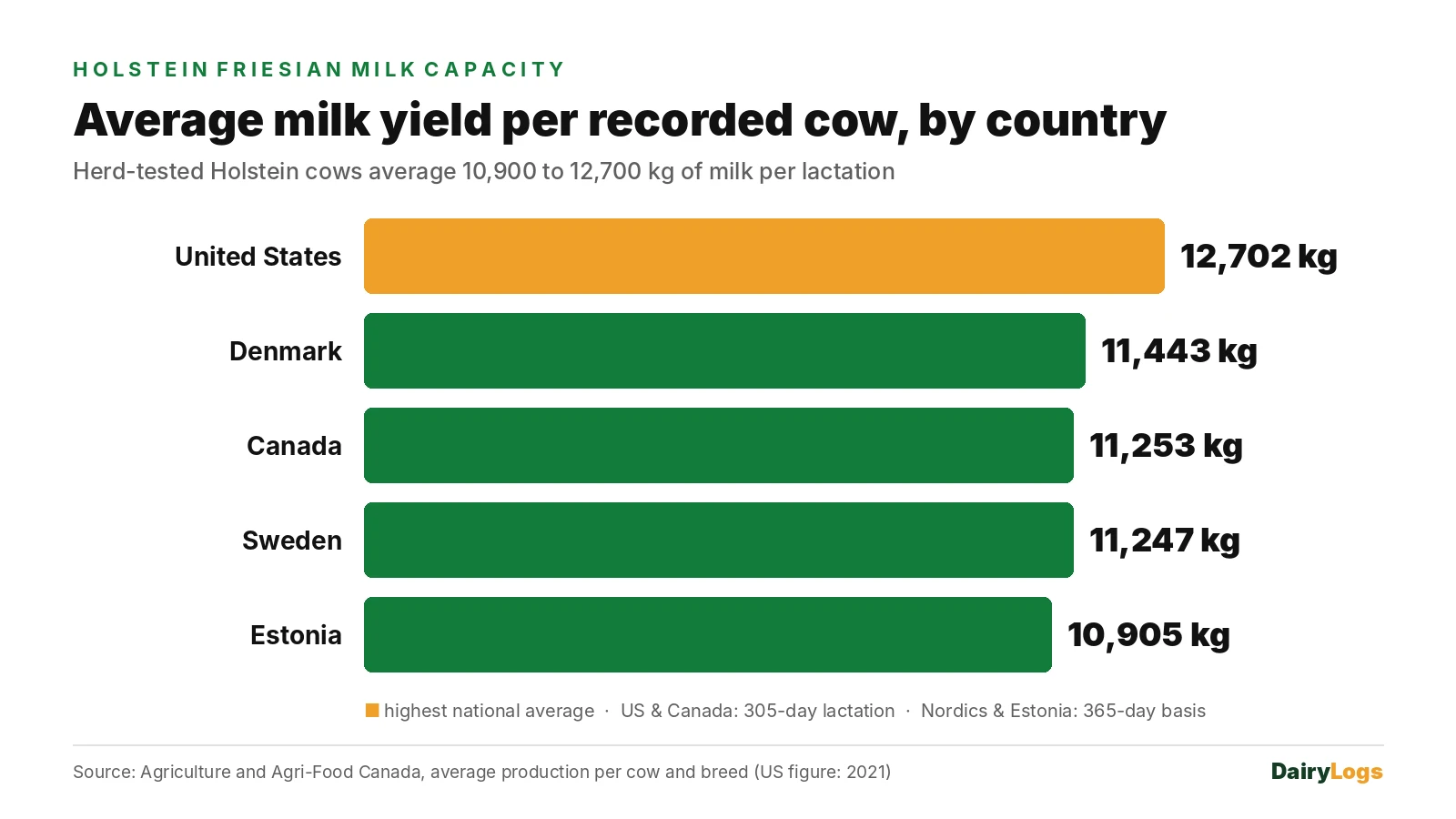
These are recorded cows. Herds that pay for milk recording are usually better managed than the national average, so treat 11,000–12,700 kg as a high-input benchmark, not a promise.
The breed ceiling is far higher. The world record Holstein, Selz-Pralle Aftershock 3918 from Wisconsin, produced 78,170 lb (about 35,460 kg) of milk in 365 days in 2017.
Your herd's number is the one that matters. The gap between the breed average and your own bulk tank is where the profit is hiding, and you only see it with per-cow records.
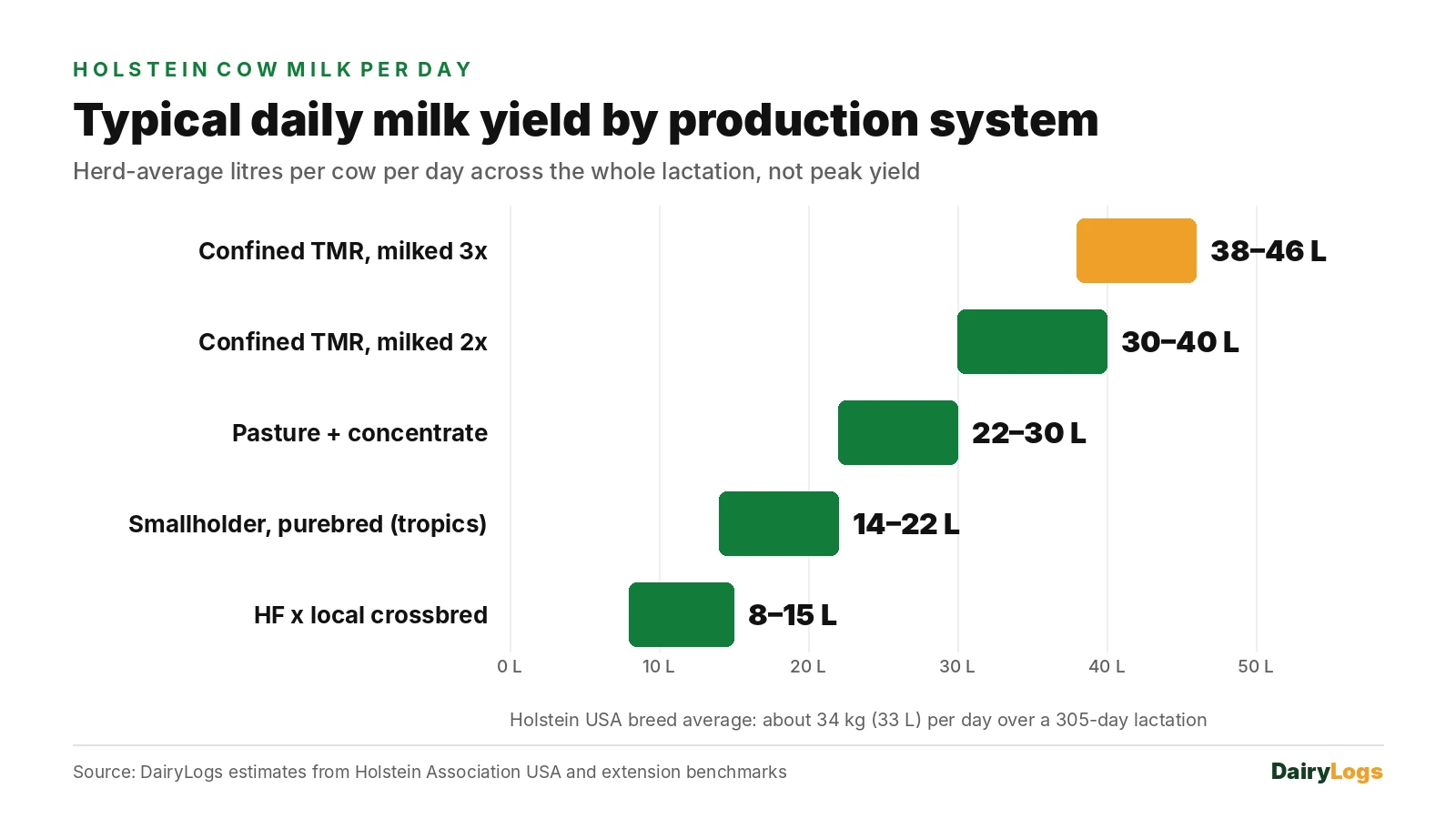
Holstein Association USA puts the average at about 75 lb (34 kg, or roughly 33 litres) per day across a 305-day lactation. On real farms, the system the cow lives in matters more than her pedigree.
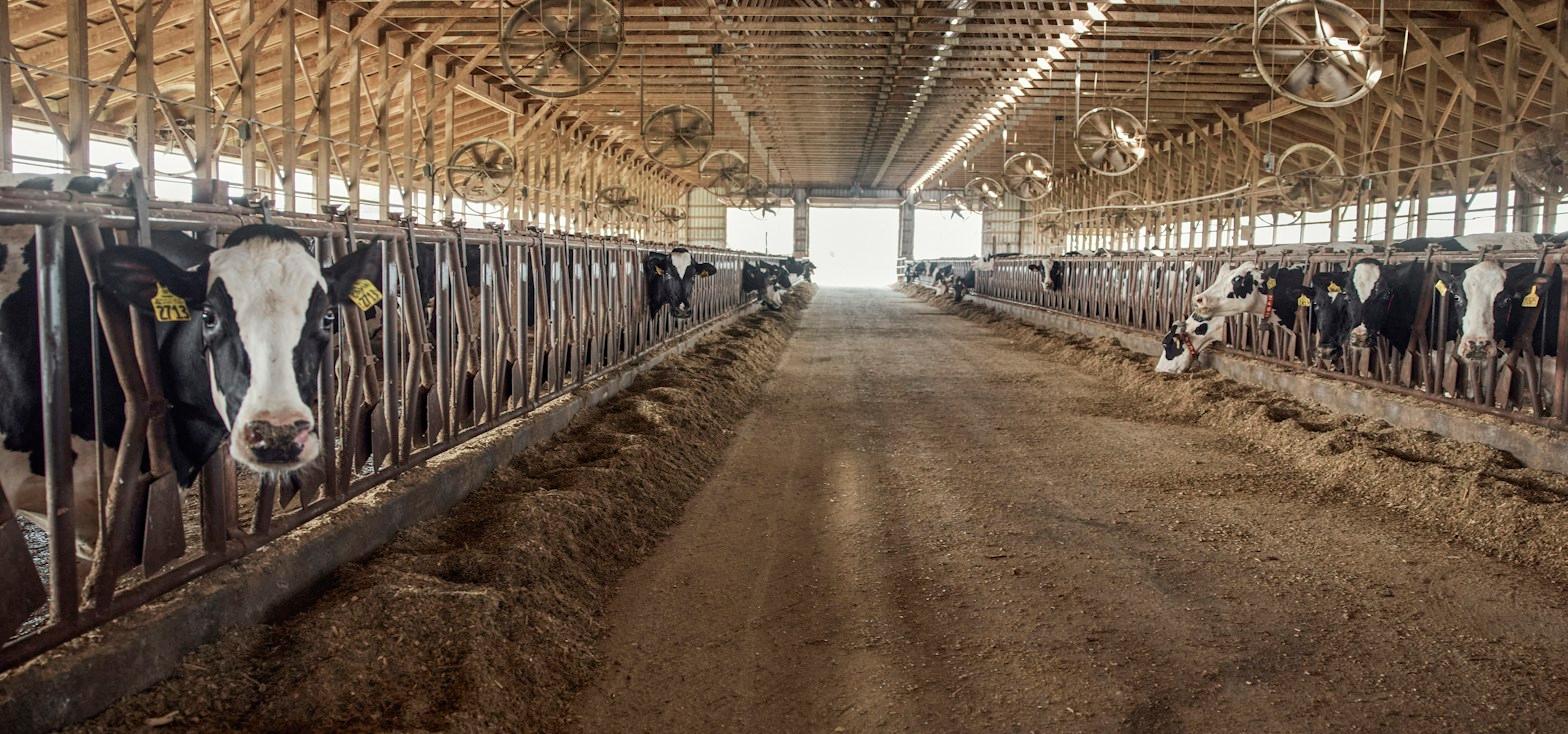
Production system | Herd-average milk per day | Typical peak |
|---|---|---|
Confined TMR barn, milked 3x | 38–46 L | 50–60 L |
Confined TMR barn, milked 2x | 30–40 L | 45–55 L |
Pasture plus concentrate (Australia, NZ, Ireland) | 22–30 L | 30–40 L |
Smallholder, purebred Holstein in the tropics | 14–22 L | 20–28 L |
Holstein Friesian x local crossbred | 8–15 L | 12–20 L |
These are DairyLogs field ranges built from breed association and extension benchmarks. Use them to sanity-check a seller's claims, not to replace your own test-day weights.
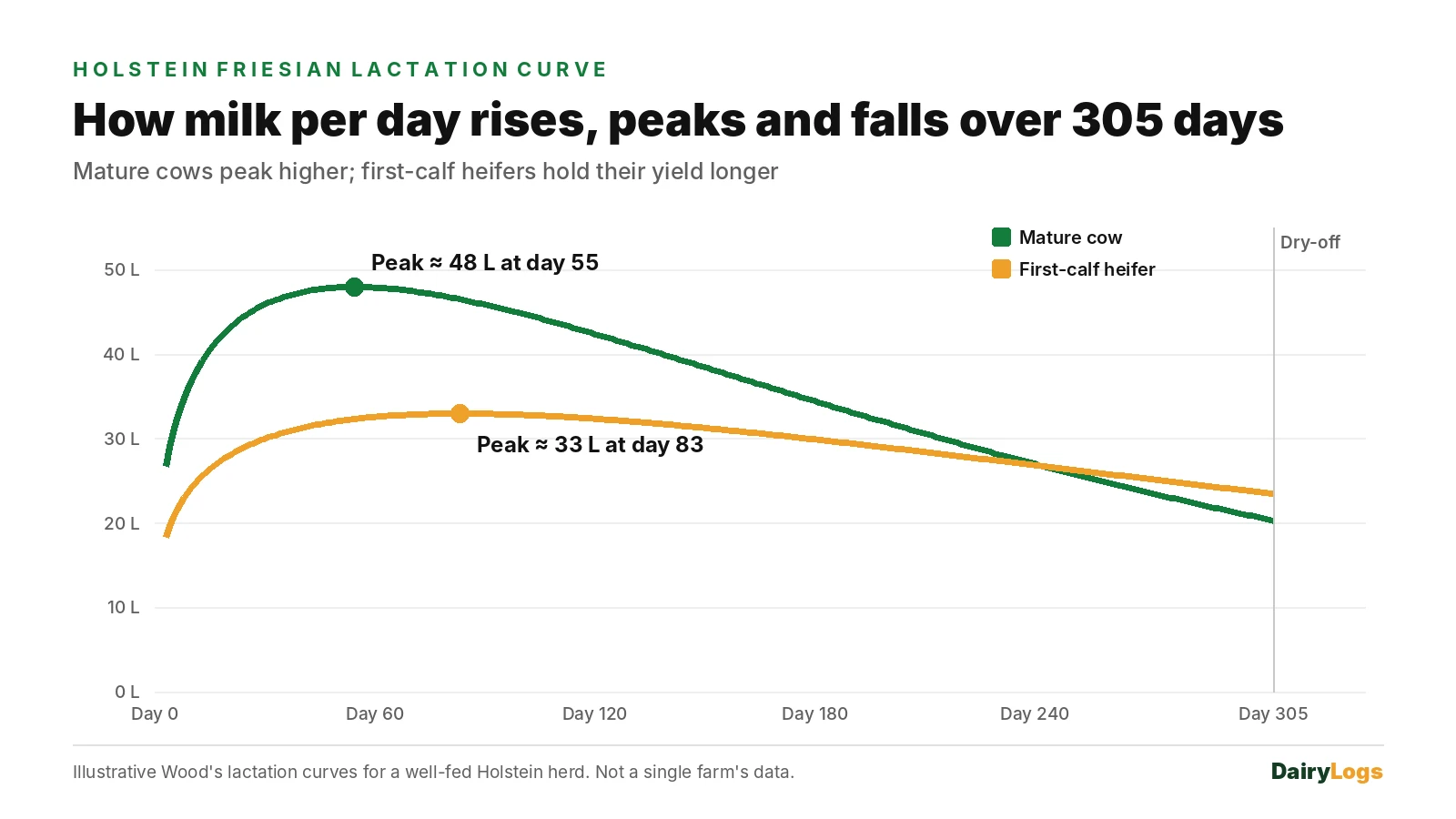
A Holstein's daily yield climbs after calving, peaks around 45–60 days in milk, then declines until dry-off. A common extension rule of thumb is that every extra 1 kg at peak adds about 200 kg over the full lactation.
Mature cows peak higher but drop faster, often losing 6–8% of daily yield per month after peak.
First-calf heifers peak lower (about 70–80% of a mature cow) but are more persistent, holding yield longer into late lactation.
A low or late peak almost always points back to the transition period: poor dry cow feeding, milk fever, retained placenta or ketosis.
Dry matter intake. A high-producing Holstein eats 3.5–4% of body weight as dry matter, which is 23–26 kg for a 650 kg cow. Empty feed bunks for even two hours a day cost milk.
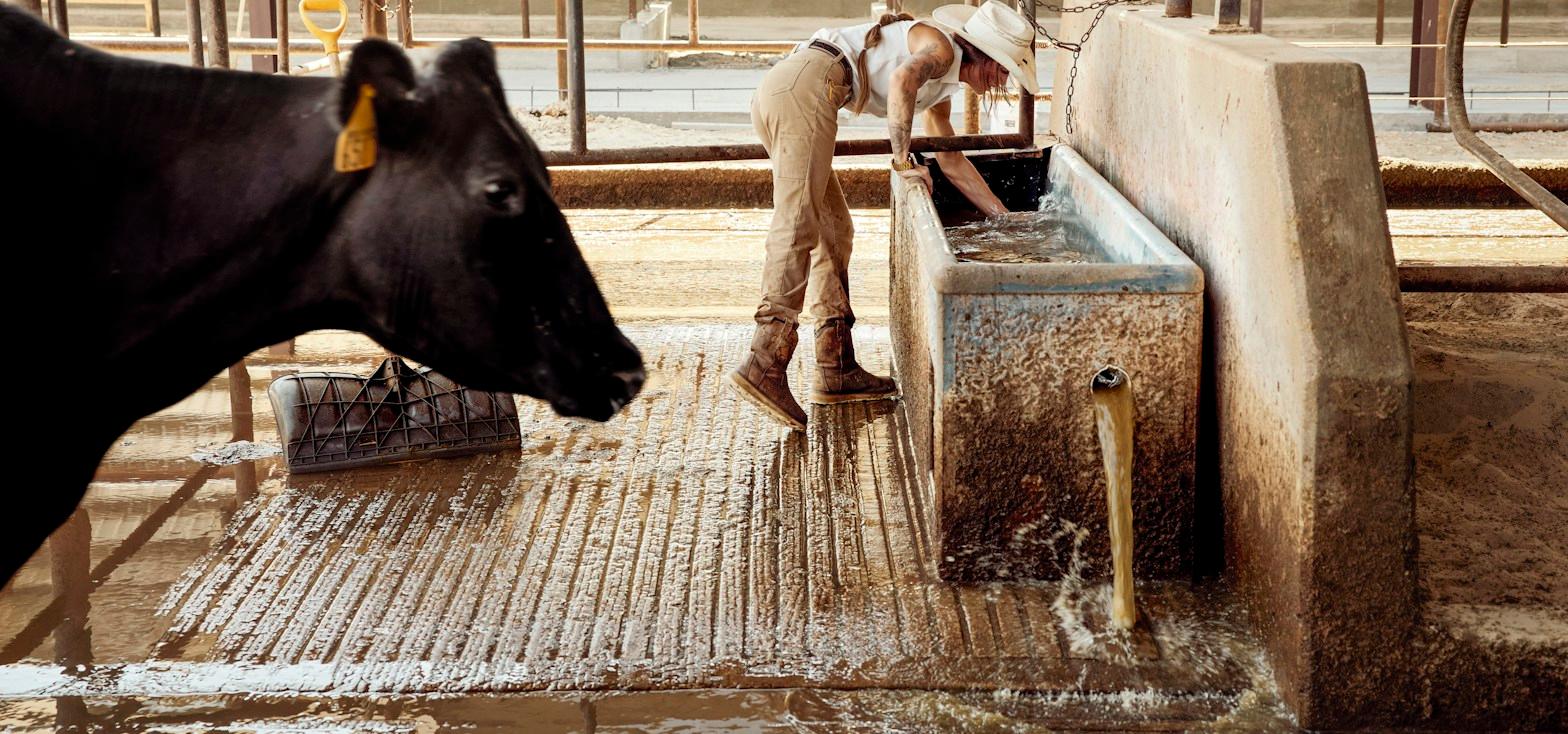
Water. Milk is about 87% water. A lactating Holstein can drink 80–150 litres a day, more in summer, so trough space and flow rate matter.
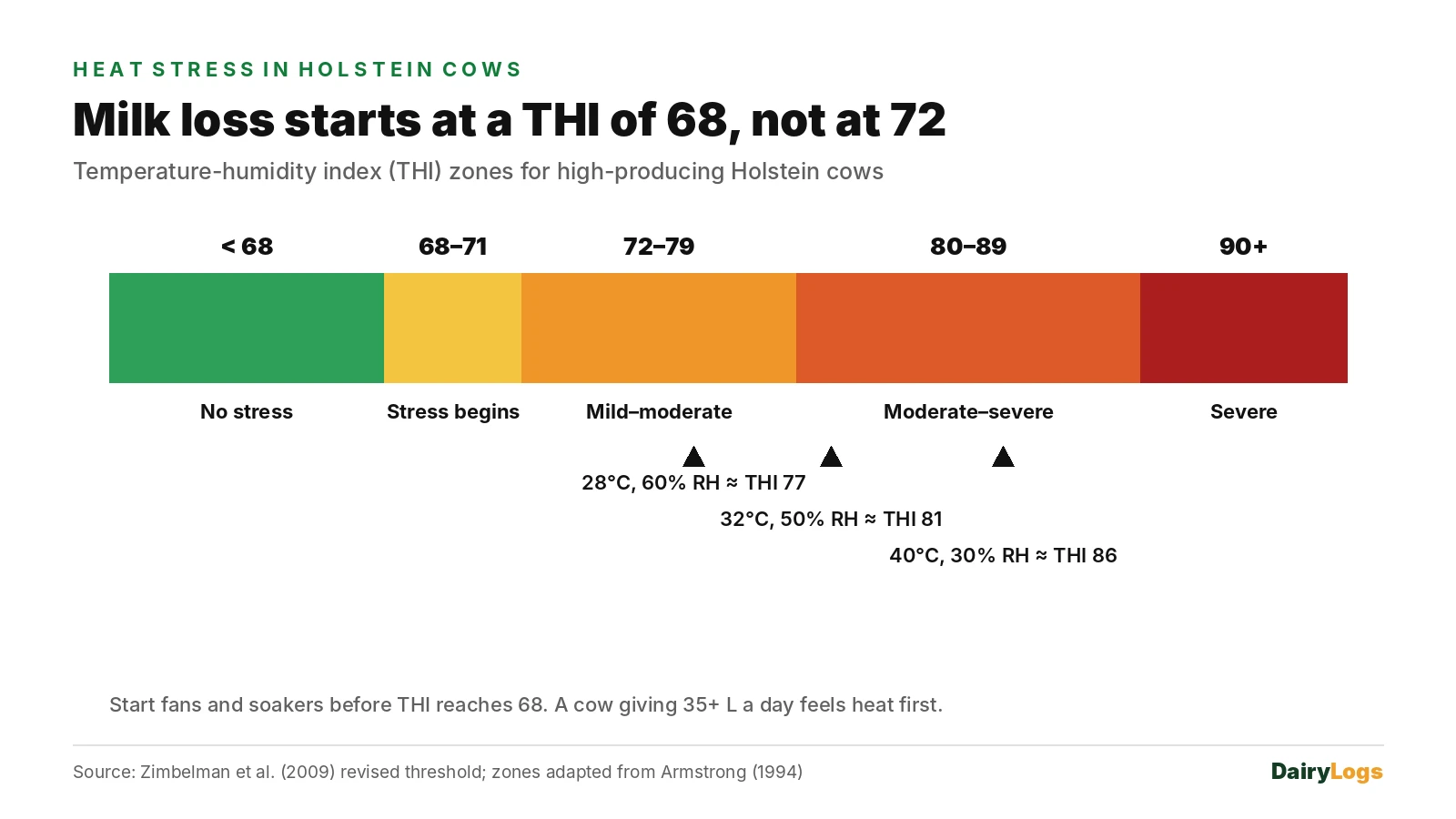
Heat stress. High-yielding Holsteins start losing milk at a temperature-humidity index (THI) of 68, well before the barn feels hot to people.
Milking frequency. Moving from 2x to 3x milking typically lifts yield by 8–15% if feed and labour keep up.
Udder health. Rising somatic cell count (SCC) means lost milk long before you see clinical mastitis.
The Holstein's high metabolic heat load makes her the least heat-tolerant major dairy breed. Research by Zimbelman and colleagues (2009) lowered the heat stress threshold for high-producing cows from a THI of 72 to 68.
In practical terms, 28°C at 60% humidity already puts a cow at THI 77. A Multan or Phoenix summer afternoon at 40°C and 30% humidity sits around THI 86.
Install fans and soakers over the feed lane and holding pen, and switch them on at THI 68.
Feed more of the ration in the cooler evening and early morning hours.
Watch for a drop in conception rate, not just milk; heat-stressed Holsteins show shorter, weaker heats.
For the full physiology, see this Washington State University veterinary extension review on heat stress in dairy cattle.
Holsteins win on volume, not on solids. Their milk typically tests around 3.7–4.1% butterfat and 3.1–3.3% protein, below Jersey milk.
Fluid milk markets that pay mainly per litre, as in most of Pakistan and South Asia, suit Holsteins well.
Component-priced markets (cheese and butter plants, most of Australia and New Zealand) reward kilograms of fat and protein, which narrows the Holstein's lead.
Bulk tank SCC should stay under 200,000 cells/mL. Holsteins with large, deep udders need tighter mastitis control as they age.
Read our guide to mastitis in cows: symptoms, treatment and prevention before you scale up a Holstein herd.
Holstein prices hit records in 2026. In the US, the shift to beef-on-dairy breeding left far fewer dairy heifers in the pipeline, and lenders such as CoBank do not expect replacement numbers to rebuild until 2027–2028.
Market and animal type | Price per head | Approx. USD |
|---|---|---|
US replacement milk cow (national average, April 2026) | $3,130 | $3,130 |
US top-quality Holstein springing heifer (May 2026) | $3,500–$4,400 | $3,500–$4,400 |
US short-bred Holstein heifer (May 2026) | $2,250–$3,500 | $2,250–$3,500 |
Pakistan, local-bred Holstein Friesian cow | PKR 300,000–800,000 | $1,070–$2,860 |
Pakistan, imported-line (Australian or Dutch) cow | PKR 1.4–1.5 million | $5,000–$5,360 |
US figures are USDA estimates and auction reports compiled by Dairy Herd Management. Pakistan figures are asking prices from BakraOnline.pk listings at about PKR 280 per US dollar.
Pregnancy stage: a springer due within 30 days carries the biggest premium because she starts earning almost immediately.
Lactation number: second- and third-lactation cows sell above older cows with more udder and hoof wear.
Proof of yield: test-day milk records and a clean SCC history are worth more than a seller's "she gives 30 litres" claim.
Genetics: registration papers, genomic test results and A2A2 status add value in premium markets.
Health history: past mastitis, lameness, abortion or difficult calvings should cut the price sharply.
The purchase price only makes sense when you spread it across the milk the cow will produce in her life. Use this simple formula:
Replacement cost per litre = (purchase price − cull value) ÷ lifetime litres
Take a $3,800 springer with a $1,500 cull value that gives 10,000 litres per lactation. Over three lactations, her replacement cost is about $0.077 per litre. If she leaves after two lactations, that jumps to $0.115.
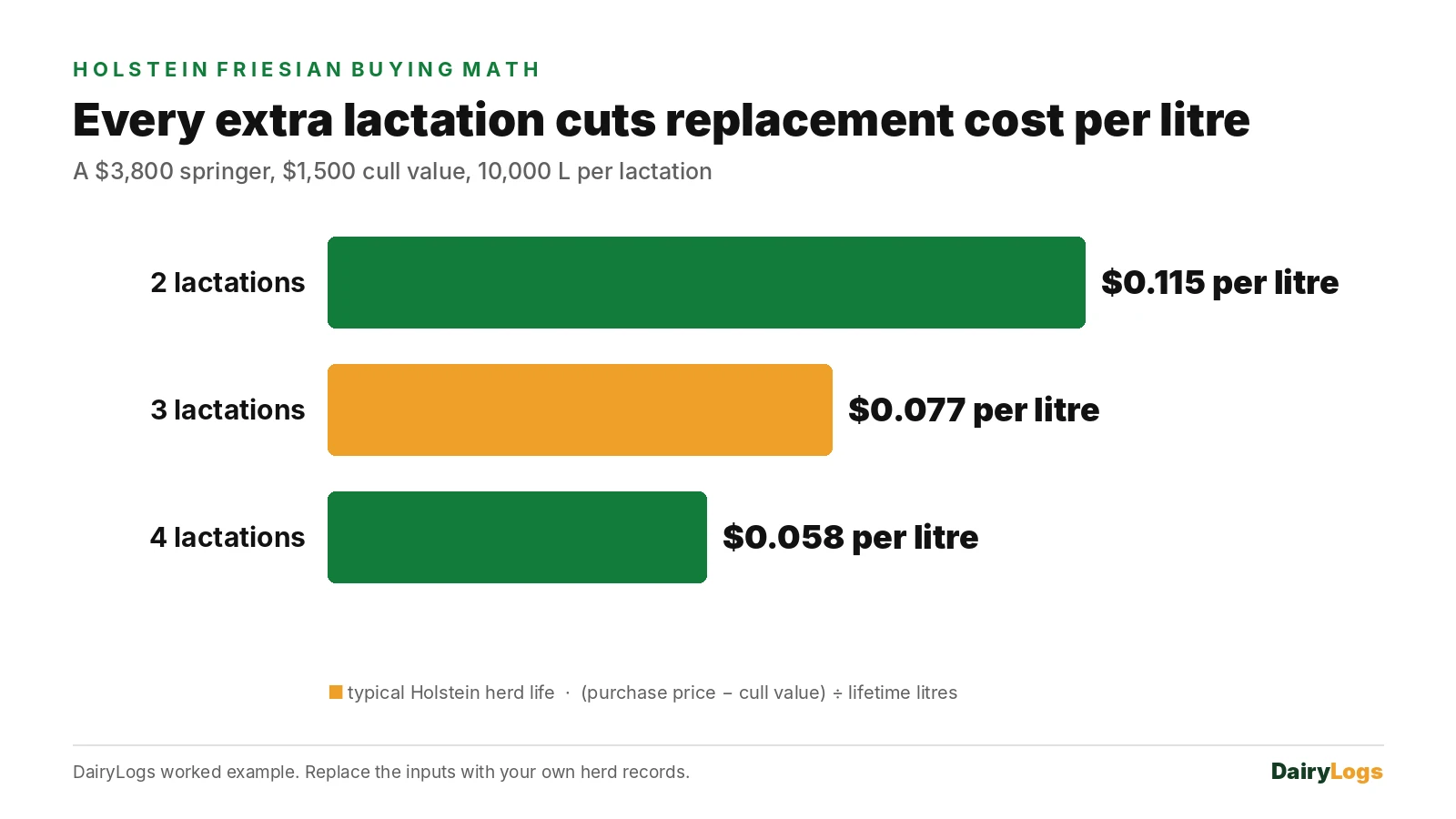
Add feed cost per litre from your own ration and you have a real buy-or-pass number. DairyLogs calculates this automatically in the cost-per-litre report.
High-yield Holsteins respond to precision. These steps protect both litres and fertility.
Record test-day milk weights for every cow at least monthly. Track peak yield and days in milk in DairyLogs milk recording so you can spot cows that never hit their peak.
Target first calving at 23–25 months. Heifers that calve late cost you rearing feed and lost lifetime milk.
Tighten heat detection. High-producing Holsteins can show standing heat for under 8 hours. Use activity data and the DairyLogs heat detection calculator to predict the next cycle.
Hold the calving interval near 13 months. Every extra day open pushes more of the cow's life into low-yield late lactation.
Plan a 45–60 day dry-off period. Shorter dry periods reduce yield in the next lactation; longer ones waste feed.
Cool cows from THI 68. Fans and soakers pay back fastest in your highest-yielding group.
Cull on data, not on feel. Compare each cow's income over feed cost with the value of a replacement before you sell or keep her.
Trait | Holstein Friesian | Jersey | Girolando (5/8) |
|---|---|---|---|
Milk volume | Highest | Moderate | Moderate |
Fat and protein % | Lowest | Highest | Medium |
Heat tolerance | Low | Medium | High |
Feed demand | Highest | Lower | Lower |
Best fit | Cooled barns, TMR, fluid milk markets | Pasture, component pricing | Hot climates, low-input systems |
Choose the Holstein Friesian when you can feed a balanced ration, cool cows in summer and keep individual records. Without those three, a crossbred or a more heat-tolerant breed often makes more profit per cow. Compare options in our list of the highest milk yielding cow breeds.
A Holstein Friesian cow averages about 33 litres (75 lb) of milk per day over a 305-day lactation. Well-managed mature cows in cooled TMR barns peak at 45–55 litres, while purebred Holsteins on smallholder farms in hot climates usually average 14–22 litres.
In 2026, top-quality Holstein springing heifers sold for $3,500–$4,400 at US auctions, and the national average for a replacement milk cow was about $3,130. In Pakistan, local-bred Holstein Friesian cows are listed for PKR 300,000–800,000, and imported-line cows for PKR 1.4–1.5 million.
They share the same Dutch origin. The Holstein type was bred in North America for maximum milk volume and size, while the Friesian type in Britain, Ireland and New Zealand stayed smaller and more robust on pasture. Most markets now call the combined breed the Holstein Friesian.
The Holstein Friesian is still the breed to beat for litres: about 10,400 kg per lactation on average and far more in top herds. That output only shows up in your bulk tank when feed, cooling, fertility and udder health are managed cow by cow.
Next step: start a free digital herd record in DairyLogs, log your first test-day milk weights, and see each Holstein's real milk per day and cost per litre. Start free with DairyLogs.
Want tools that match these practices? Start free with DairyLogs.