Hypophosphatemia in cows can down fresh cows and cut milk. Learn the signs, ration targets and a prevention checklist to protect your herd.
Herd Health·Nov 22, 2026·Dr Hassan Shahzad

Hypophosphatemia in cows is abnormally low blood phosphate, usually caused by a ration short on phosphorus around calving. It can trigger weakness, downer cow syndrome, anemia and red urine. Vets treat it with phosphate therapy; you prevent it by feeding about 0.32–0.38% phosphorus in lactating-cow dry matter.
A fresh cow that stops eating, drops milk and will not rise is easily blamed on milk fever or ketosis. Phosphorus deficiency in cows is the suspect many herds miss. This guide covers the signs, the vet's tests, treatment, and the ration and record-keeping steps that prevent it.
Hypophosphatemia means low inorganic phosphate (Pi) in the blood. Phosphorus is more than a bone mineral: it powers energy metabolism through ATP, and as part of 2,3-DPG it helps red cells release oxygen to tissues.
About 85% of body phosphorus sits in the skeleton, while less than 1% circulates in blood and other extracellular fluid. That small circulating pool drains fastest when milk production starts, so risk peaks in early lactation. See the Merck Veterinary Manual overview of phosphorus disorders for the physiology.
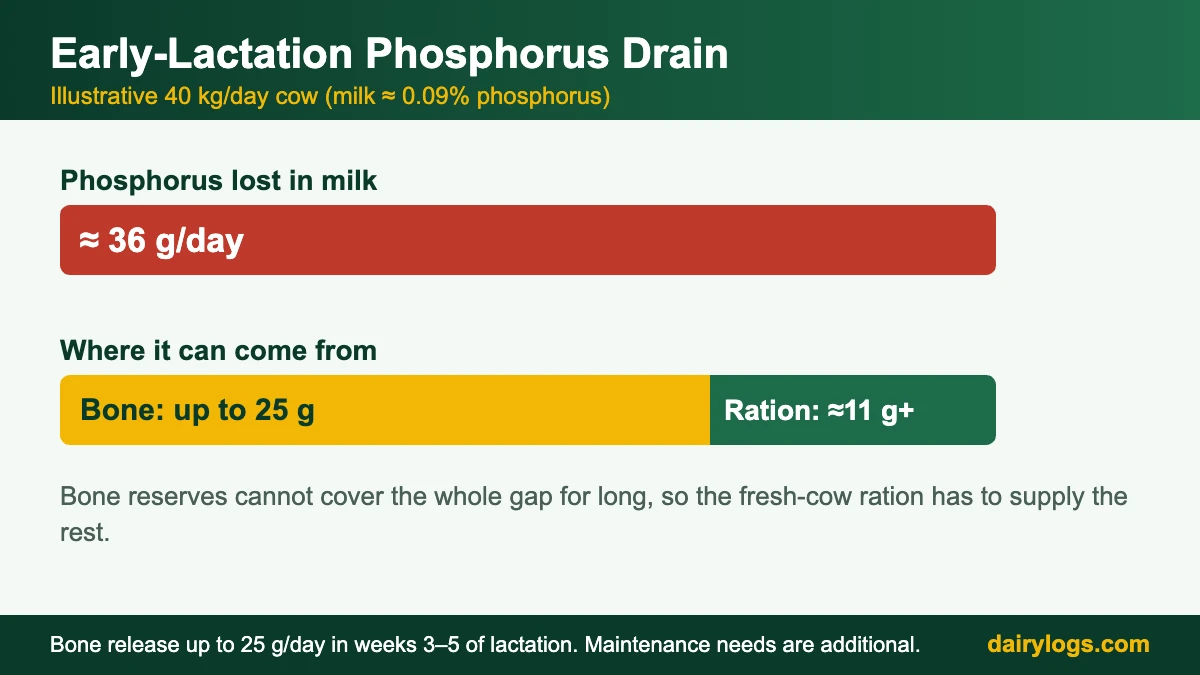
The numbers on a high-yielding herd are sobering. Milk contains about 0.09% phosphorus, so a cow giving 40 kg a day loses roughly 36 g of phosphorus in milk alone. A published phosphorus requirement review reports cows mobilizing up to 25 g/day from bone in the first 3 to 5 weeks of lactation, so the ration has to cover the rest.
Across species, hypophosphatemia is linked to low intake, prolonged anorexia or conditions that disturb phosphorus balance. In ruminants it is most often a feeding problem, such as grazing phosphorus-deficient soils or feeding low-phosphorus rations.
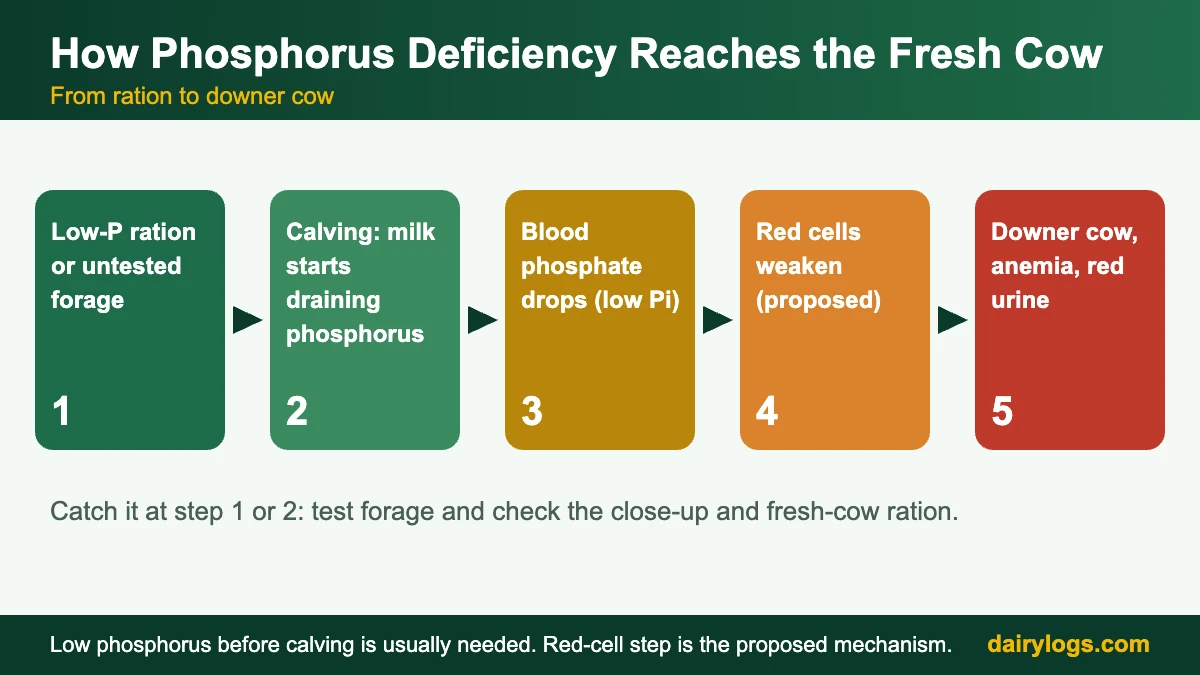
Dairy cows add a distinctive acute form around calving: postparturient hemoglobinuria (PPH) and hypophosphatemic downer cow syndrome.
Phosphorus deficiency in cows is almost always a feeding problem layer
ed on a sudden jump in demand at calving. The usual drivers are:
Low-phosphorus rations: an insufficient dietary supply is the most common primary cause.
Phosphorus-poor forage or soils: grazing deficient pasture or feeding forage that was never tested.
Restricted dry and close-up diets: a period of phosphorus deprivation before calving is usually needed for the acute form to develop.
Sudden milk phosphorus loss: the drain at the start of lactation can overwhelm the cow's compensatory mechanisms.
Prolonged low intake: chronic disease or poor appetite lowers phosphorus intake as a secondary cause.
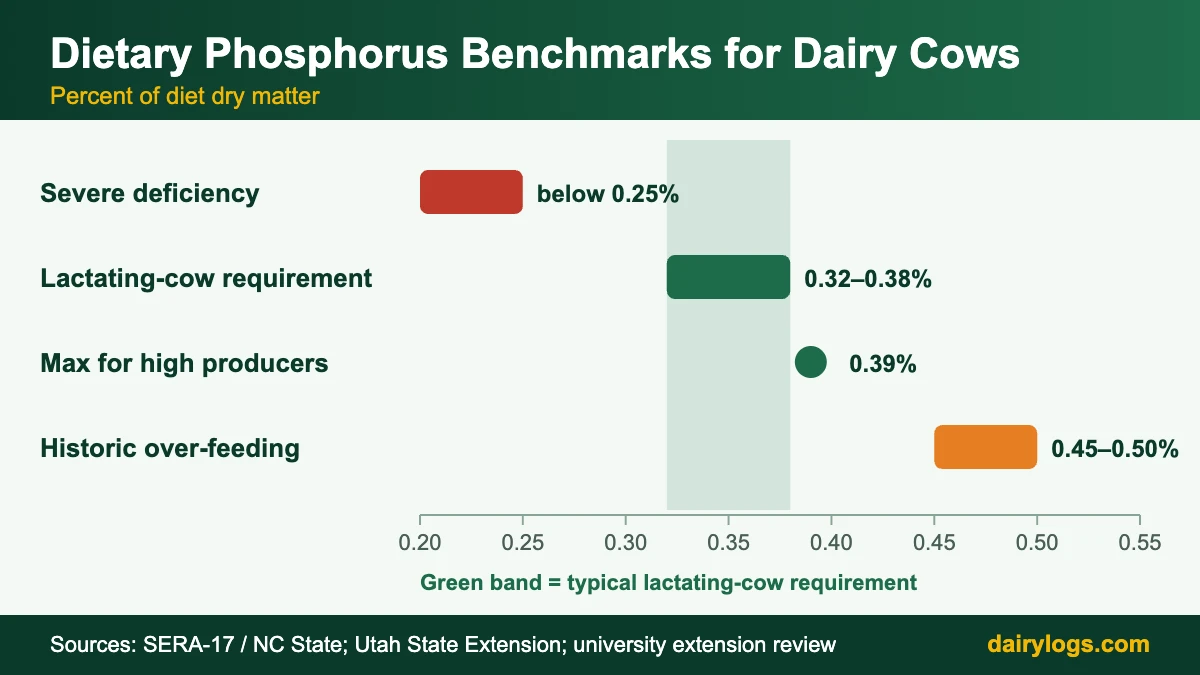
Severe deficiency, below 0.25% of dietary dry matter, is where reproductive performance has been shown to suffer.
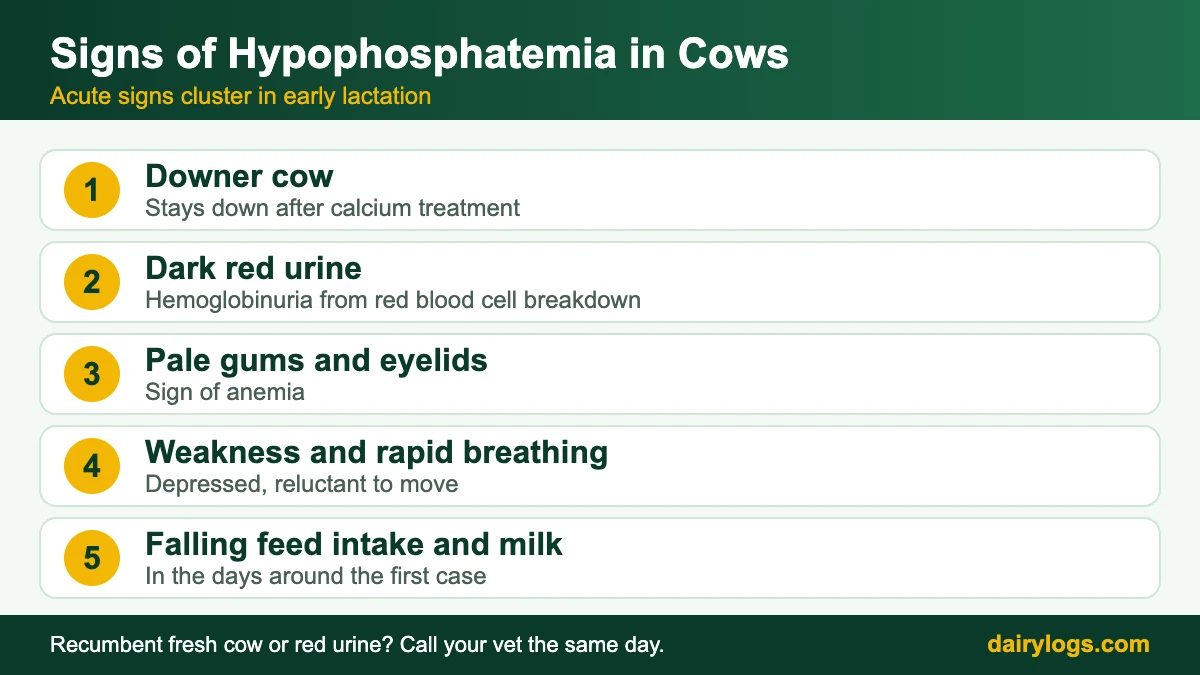
Acute cases cluster in early lactation. Watch for:
Recumbency or a downer cow that does not stand despite calcium treatment
Dark red or coffee-colored urine (hemoglobinuria) from red blood cell breakdown
Pale gums and eyelid membranes from anemia
Weakness, depression and rapid breathing
Falling feed intake and milk yield in the days around the first case
PPH is the dramatic end of the spectrum. In a 2023 study in Animals, late-pregnant cows fed a low-phosphorus diet from four weeks before to four weeks after calving developed severe anemia and hemoglobinuria in a subset of animals, and researchers also found a subclinical form.
Unthriftiness and poor body condition
Pica, such as licking or chewing wood, soil or bones
Reduced appetite across a group
Slow growth and bone deformities in young stock
For wider context, compare these signs with our guide to common dairy cattle diseases.
Condition | Usual timing | Key clue |
|---|---|---|
Milk fever (hypocalcemia) | Usually within 72 hours of calving | Cow improves or rises after calcium treatment |
Hypophosphatemic downer cow | Early lactation | Stays down after calcium; low blood phosphate |
Postparturient hemoglobinuria | First weeks of lactation | Red or dark urine, pale membranes, anemia |
Never assume the cause. A recumbent fresh cow needs a vet, because treating the wrong mineral wastes critical hours.
Diagnosis combines history, clinical exam and blood work. Blood inorganic phosphate is the standard test, but it is only a crude indicator of recent dietary phosphorus intake and says little about total body status.
That makes ration and feed records as important as the blood sample. A practical workup looks like this:
Call your vet for any recumbent fresh cow or any red-urine case.
Sample blood from several cows in the same calving group, not only the sick one.
Ask for a packed cell volume or blood count to confirm anemia.
Send forage and TMR samples for phosphorus analysis.
Compare the analyzed ration with the 0.32–0.38% target.
Treatment is a veterinary decision, and timing matters. Your vet may give phosphate intravenously or by mouth, supportive fluids and, in severe PPH anemia, a blood transfusion.
Do not give IV phosphate yourself. Phosphate products can lower blood calcium and cause harm if the product, dose or rate is wrong.
While you wait for the vet:
Keep a recumbent cow on deep bedding or a non-slip surface and help her change sides regularly.
Keep water and fresh feed within reach.
Record every treatment and its milk withdrawal period.
Ask your nutritionist to re-check the whole group's ration the same day.
Prevention is ration management, not blanket extra phosphorus. Follow these steps:
Formulate to requirement. Most lactating cows meet phosphorus needs at about 0.32–0.38% of dry matter, with 0.39% as the upper recommendation for high producers.
Test forage each cutting. Phosphorus varies by soil and maturity, so book values drift from real values.
Protect the close-up diet. Confirm with your nutritionist that dry and close-up groups are not being phosphorus-starved before calving.
Group by production level. Matching phosphorus to each group's requirement avoids both shortfalls and waste.
Monitor intake. Cows that eat less take in less phosphorus, so catch low intake in fresh-cow checks.
Check mineral delivery. Weigh the dicalcium phosphate or mineral mix actually fed per head against the formulated rate.
Benchmark | % of diet dry matter | Source |
|---|---|---|
Lactating cow requirement (most herds) | 0.32–0.38% | |
Maximum for high-producing cows | 0.39% | SERA-17 / NC State |
Typical diet before mineral phosphorus | 0.35–0.40% | SERA-17 / NC State |
Historic over-feeding | 0.45–0.50% | |
Severe deficiency (reproduction suffers) | Below 0.25% | University extension review |
Over-correcting does not help. Utah State Extension estimates that cutting dietary phosphorus from 0.45% to 0.35% of dry matter saves $1,800 to $2,000 a year for a 100-cow herd, and phosphorus fed above requirement is excreted in manure.
Hypophosphatemia rarely shows up in a single cow. Three fresh cows down in the same fortnight on the same close-up TMR is a ration flag, not bad luck. A 120-cow herd calving 10 cows a month can spot that pattern within weeks if events are recorded.
Log every downer case, red-urine event and treatment, including milk withdrawal, using the step-by-step guide to logging health treatments.
Attach each group's ration version in DairyLogs feed management to see which recipe preceded each case.
Review days in milk at onset to confirm whether cases cluster in the first weeks of lactation.
The most common cause is a ration that supplies too little phosphorus, such as untested low-phosphorus forage or a restricted close-up diet. The sudden phosphorus loss in milk at the start of lactation can then overwhelm the cow's compensatory mechanisms. Prolonged poor appetite from disease is a secondary cause.
In fresh cows, early signs include falling appetite, weakness and a milk drop, followed in severe cases by a downer cow or dark red urine. In the wider herd, look for pica and poor condition. Any recumbent fresh cow or red urine needs a vet the same day.
Most lactating cows meet their requirement at about 0.32–0.38% phosphorus in diet dry matter, with 0.39% as the upper recommendation for high producers. Your nutritionist should set the exact figure for your milk yield and dry matter intake, using tested forages.
Hypophosphatemia in cows is uncommon in a well-fed herd and costly in one that is not. Balance phosphorus to the 0.32–0.38% window, test forages, protect intake around calving, and treat any red-urine or downer-cow case as a signal about the whole group's ration.
Next step: start your digital herd record with DairyLogs health tracking and log every fresh-cow event from day one.
Want tools that match these practices? Start free with DairyLogs.