Herd Health·Nov 15, 2026·DairyLogs Team
Learn to spot calf scours early, score dehydration with the skin pinch test, and treat with electrolytes before a sick calf becomes a dead one.

Calf scours is diarrhea in calves under five weeks old, caused mainly by E. coli, rotavirus, coronavirus, Cryptosporidium and Salmonella. Treat it by replacing lost fluid with oral electrolytes while you keep feeding milk, call a vet for any calf that cannot stand, and prevent it with fast, clean colostrum.
On most dairies, scours is the biggest killer of pre-weaned heifers, and the losses rarely come from the diarrhea itself. Calves die from dehydration, acidosis and low blood sugar that build up over 24 to 48 hours. This guide shows you how to score a scouring calf in under a minute, what to feed it, when to call the vet, and how to stop the next outbreak.
Scours is the farm term for calf diarrhea (or calf diarrhoea): loose to watery manure in a calf, usually within its first month. A scouring calf can lose 5–10% of its body weight in fluid in a single day. That is 2–4 litres for a 40 kg Holstein heifer.
The fluid carries sodium, potassium and bicarbonate out with it. That causes the four problems that actually kill calves:
Dehydration: blood volume drops, circulation fails and the legs and mouth go cold.
Metabolic acidosis: lost bicarbonate makes the blood acidic, so the calf becomes dull and stops suckling.
Hypoglycemia: a calf that is not drinking runs out of energy fast, especially in cold weather.
High blood potassium: this can disrupt the heart rhythm in severe cases.
The scale of the problem is well documented. USDA NAHMS dairy surveys attribute more than half of all pre-weaned heifer deaths on US dairies to scours and other digestive problems [External Link: USDA APHIS NAHMS Dairy 2014 heifer calf health and management report].
Loose manure is the obvious sign, but by the time you see watery scour on the hutch floor, the calf may already be 5–8% dehydrated. Teams that catch scours early spot the behaviour changes first.
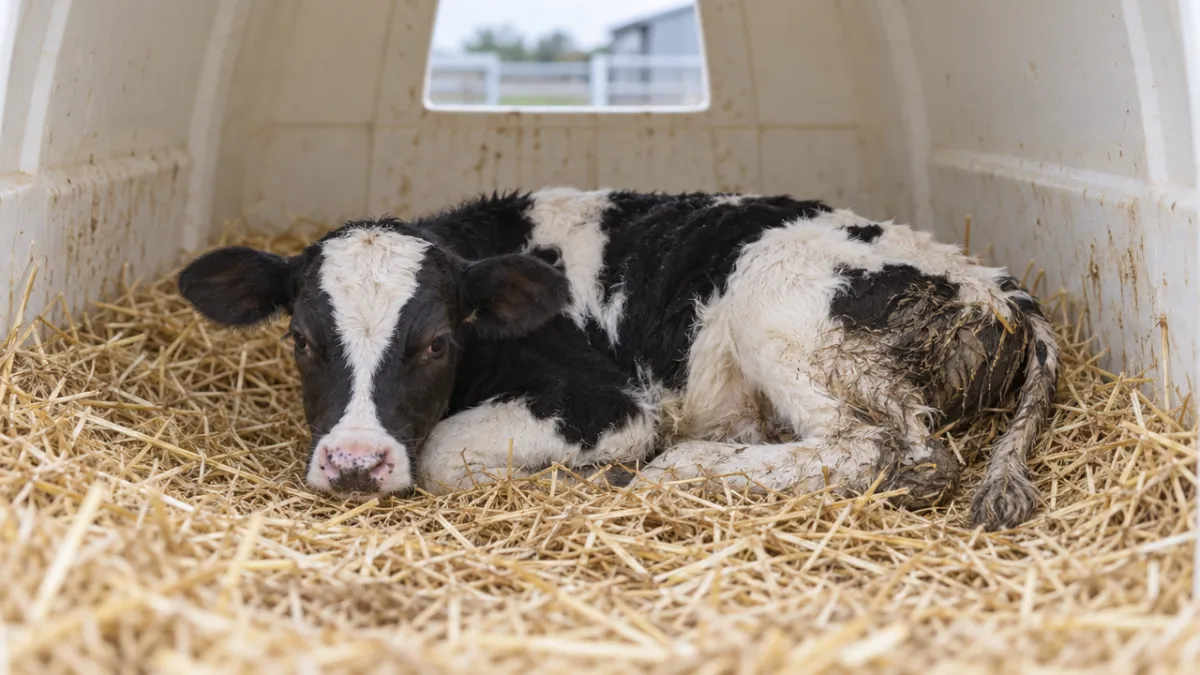
A dull calf that is slow to get up is often the first sign of scours, before the manure turns watery.
A calf that is slow to get up or does not come to the front of the hutch at feeding time
Milk left in the bottle or bucket, or a weak, chewing suckle reflex
Manure that is pasty, yellow, grey or watery, or that contains mucus or blood
A wet, dirty tail and hindquarters
Sunken flanks, drooping ears and a dull coat
A rectal temperature above 39.5°C (103°F), which points to infection, or below 38°C (100.5°F), which points to shock
The skin pinch test is the fastest way to estimate calf dehydration. Pinch a fold of skin on the upper eyelid or the side of the neck, twist it slightly, let go, and count the seconds until it flattens. Then check how far the eyeball has sunk into its socket.
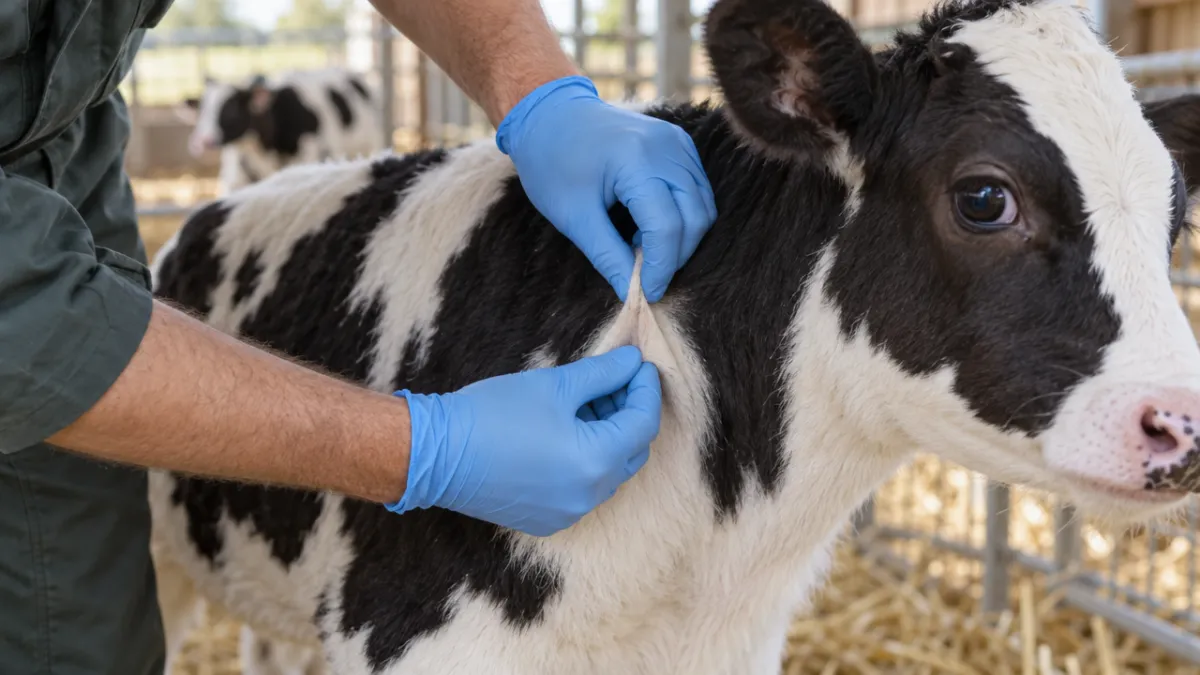
The skin pinch test: count how many seconds the skin fold takes to flatten.
Dehydration | Skin tent returns in | Eyes | Calf behaviour | Action |
|---|---|---|---|---|
Under 5% | Under 2 seconds | Normal | Alert, suckles strongly | Keep feeding milk and add oral electrolytes |
6–8% | 2–6 seconds | Slightly sunken (2–4 mm gap) | Mildly dull, still suckles | Oral electrolytes 2–3 times a day on top of milk |
8–10% | 6–10 seconds | Clearly sunken (4–6 mm), dry, tacky gums | Depressed, weak suckle, stands with effort | Tube-feed electrolytes and call the vet today |
Over 10% | Over 10 seconds or stays tented | Deeply sunken (6–8 mm) | Cannot stand, cold mouth and legs | Emergency: IV fluids from a vet |
Rule of thumb: if a calf can stand and still suckles, oral rehydration usually works. If it is down, or its mouth feels cold when you put a finger inside, oral fluids will not be absorbed fast enough and it needs IV fluid therapy.
Most scours cases involve more than one pathogen, and almost all of them start with a calf whose immunity or environment has failed. The calf's age when the scours starts is your best first clue to the cause.
Pathogen | Typical age | Key signs |
|---|---|---|
E. coli (K99/F5) | 1–4 days | Profuse watery scour, rapid dehydration, can kill within 12–24 hours |
Rotavirus | 5–14 days | Yellow, watery scour, depression, often spreads through the whole calf group |
Coronavirus | 5–21 days | Similar to rotavirus but often more severe and longer lasting, sometimes with mucus |
Cryptosporidium parvum | 7–21 days | Watery, greenish scour, poor appetite, can last 7–10 days. Zoonotic, so wear gloves |
Salmonella | Any age, often over 10 days | Fever, blood, mucus or fibrin in the manure, severe depression, high death rate |
Coccidiosis (Eimeria) | Over 3 weeks | Bloody scour, straining, often follows moving or grouping calves |
On-farm rapid tests can detect rotavirus, coronavirus, E. coli K99 and Cryptosporidium from a manure sample in about 15 minutes. For outbreaks, send samples from 3–5 untreated, newly sick calves to your vet's lab so prevention targets the right pathogen [External Link: University extension guide to diagnosing neonatal calf diarrhea].
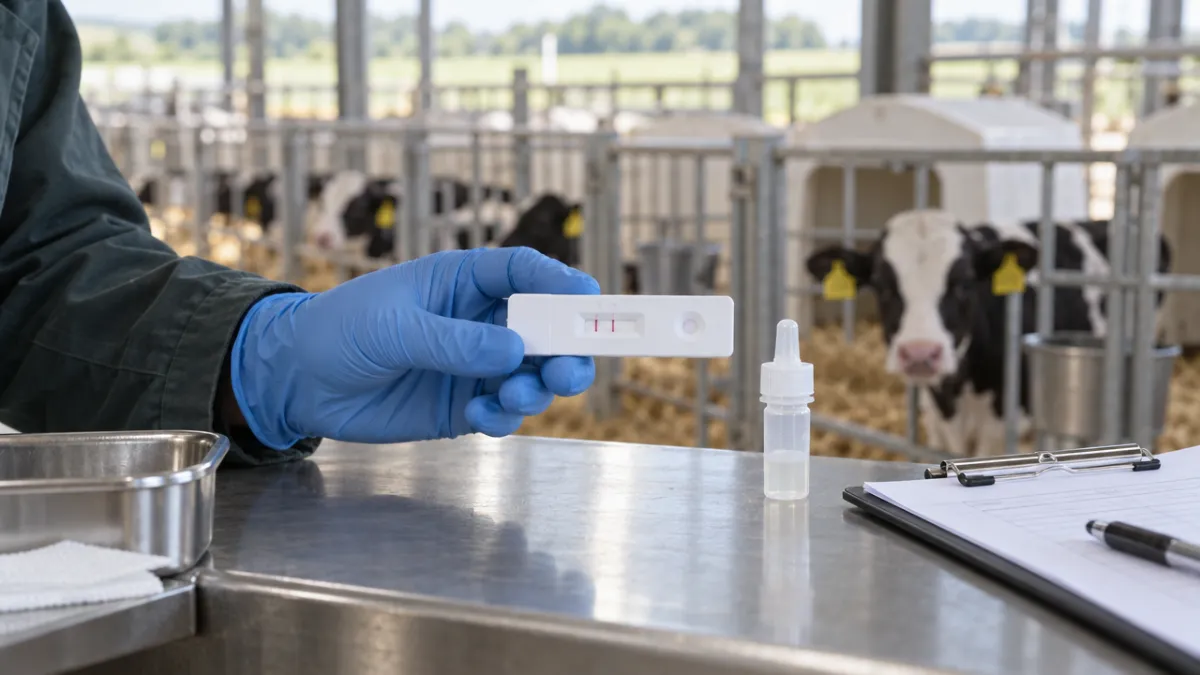
Rapid tests narrow down the pathogen in minutes. Confirm outbreaks with your vet's lab.
Feeding mistakes upset the gut and leave the door open for infection. Common culprits on commercial farms include:
Milk replacer mixed by scoop instead of by weight, which leaves solids concentration varying by 20% or more from feed to feed
Milk fed at inconsistent temperatures (aim for 38–40°C) or at irregular times
Low-quality milk replacer with a lot of non-milk protein
A sudden change from whole milk to replacer, or from one brand to another
Nutritional scours usually leaves the calf bright and drinking. If a calf with scours turns dull, assume infection.
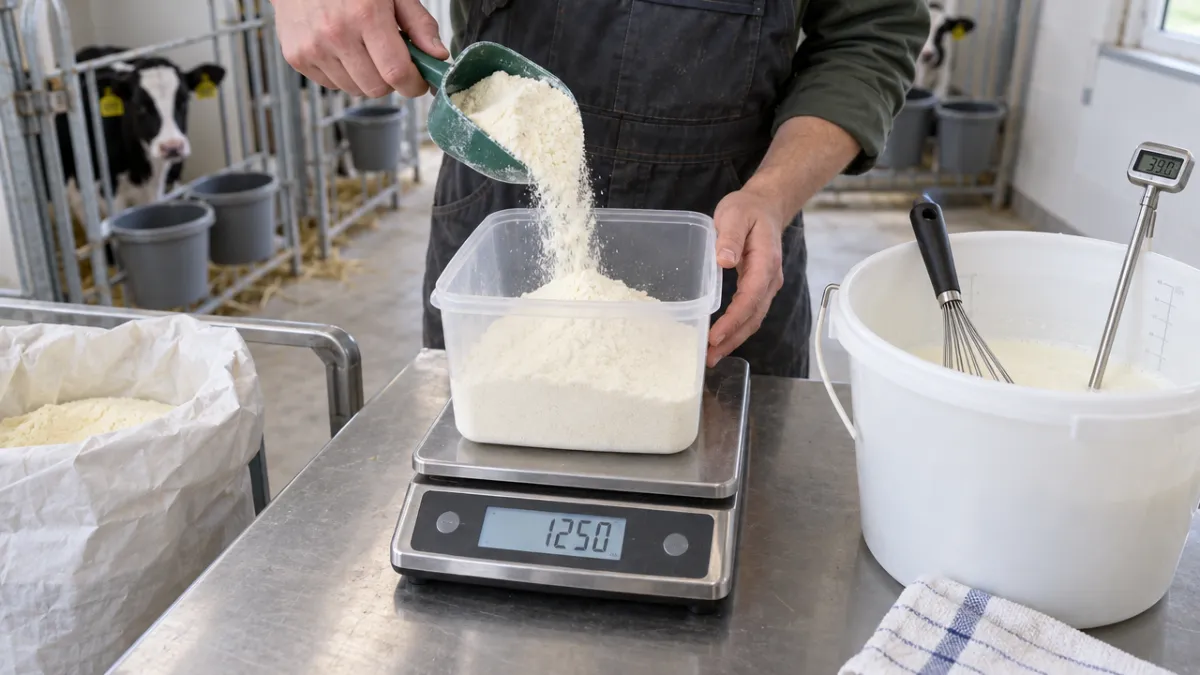
Weigh milk replacer powder for every batch instead of measuring it by the scoop.
Failure of passive transfer: calves that got too little colostrum, poor-quality colostrum, or got it too late
Dirty, wet or crowded calving pens, especially at the peak of calving
Calves left with the dam for hours, suckling dirty teats
Shared feeding equipment that is not washed between calves
Cold stress: calves under 3 weeks old burn extra energy below about 15°C (59°F)
Good scours treatment is mostly fluid, energy and nursing care. Drugs come second. Follow this order on every case:
Isolate and identify. Move the calf to a clean pen or treat it last on your round, and record its ID and the date.
Score dehydration with the skin pinch test, eye position and suckle reflex.
Take a rectal temperature and check the manure for blood.
Start oral rehydration straight away for calves that can stand and suckle.
Keep feeding milk in the calf's normal amounts.
Call your vet for calves that are down, feverish, passing blood or not improving within 24 hours.
Re-check every 6–12 hours until the calf is drinking normally on its own.
Water alone will not rehydrate a scouring calf. A proper oral rehydration solution replaces sodium, corrects acidosis and supplies energy [External Link: Veterinary review of oral electrolyte solutions for diarrheic calves].
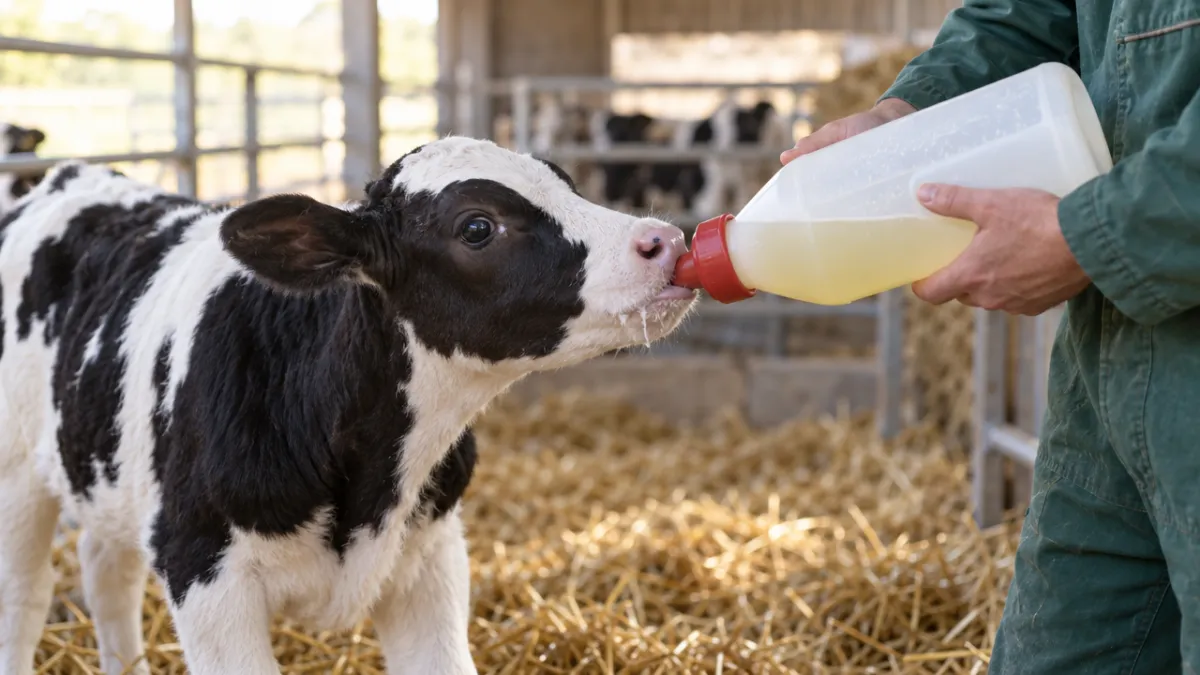
Give oral electrolytes between milk feeds while the calf can still stand and suckle.
Sodium: 90–130 mmol/L once mixed
Alkalinizing agent: bicarbonate, acetate or propionate at 50–80 mmol/L, to correct acidosis
Glucose or dextrose for energy and to help the gut absorb sodium
Bicarbonate products: give them at least 2 hours apart from milk feeds. Acetate-based products can usually be given closer to milk, but check the label.
Use this simple calculation: body weight (kg) × % dehydration = litres of fluid lost. A 40 kg calf at 8% dehydration has a deficit of 3.2 litres.
Replace that deficit within 24 hours on top of its normal milk, plus 1–2 litres or more for ongoing losses if the scour is still watery. In practice, that usually means two to three extra 2-litre electrolyte feeds a day.
If the calf will not drink, use an esophageal tube feeder, but only while it can still stand and swallow. Tubing a calf that is lying flat risks fluid going into the lungs.
Withholding milk is old advice and it costs calves. Research shows that calves kept on milk during scours lose less weight and their gut heals faster, because electrolytes alone carry only a fraction of a calf's daily energy needs. Feed the normal amount of milk, split into smaller, more frequent feeds if appetite is low.

Call the vet early for calves that are down, feverish or passing blood.
The calf cannot stand or has no suckle reflex
Its mouth or legs feel cold
It has a fever over 39.5°C, or a temperature below 38°C
There is blood, mucus or tissue in the manure
More than 2–3 calves get sick in the same week
A calf shows no improvement after 24 hours of electrolytes
Most scours is caused by viruses or protozoa, so routine antibiotics do not help. Reserve them, on your vet's prescription, for calves with fever, depression, blood in the manure or signs of infection spreading through the body.
Vets may also prescribe an anti-inflammatory such as meloxicam to get calves drinking sooner, or a product that controls Cryptosporidium where one is licensed. Record every treatment along with its withdrawal period before any calf is sold or slaughtered.
A calf is born with almost no antibodies, so colostrum is its only early protection against scours. Every calf rearing protocol should include the colostrum management standards below [External Link: Penn State Extension colostrum management guidelines].
Quality: feed only colostrum reading 22% or higher on a Brix refractometer, which is roughly 50 g/L of IgG or more
Quantity: feed 10–12% of birth weight at the first feed, which is about 4 litres for a 40 kg calf
Quickly: feed within 2 hours of birth, ideally within the first hour
sQueaky clean: keep the total bacteria count under 100,000 cfu/mL, and collect, store and feed with clean equipment
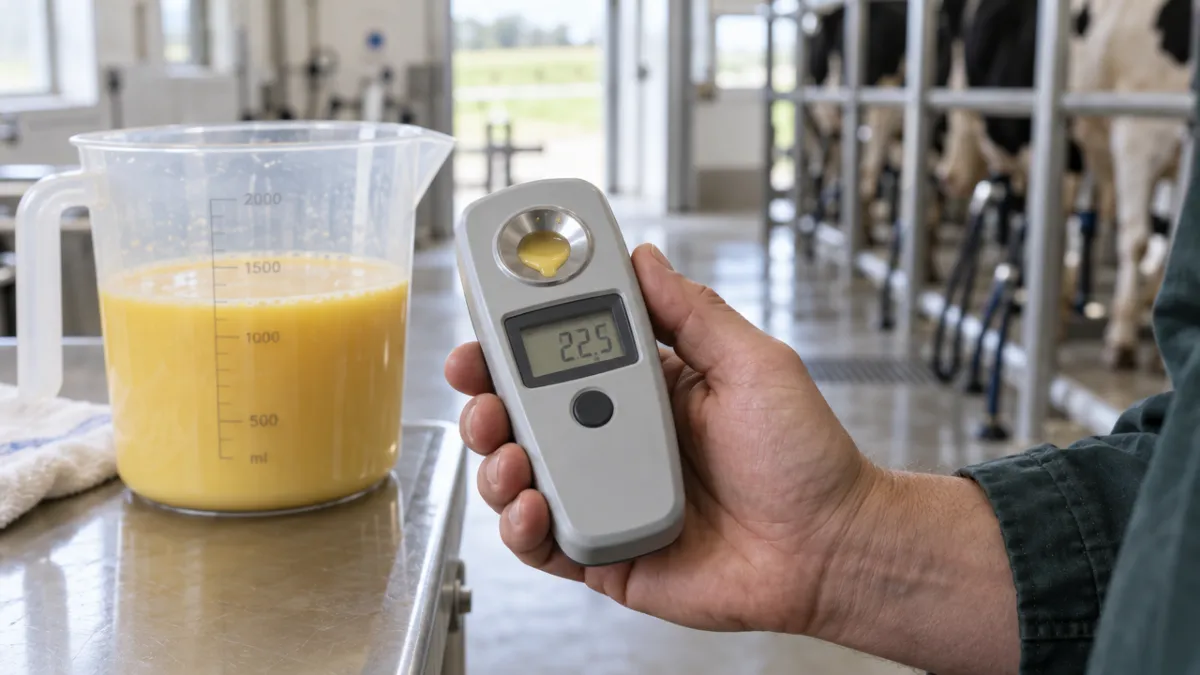
Colostrum that reads 22% Brix or higher is good enough to feed to newborn calves.
Blood-test 12 or more calves aged 1–7 days each month. The industry consensus targets for passive transfer are:
Category | Serum Brix % | Serum total protein (g/dL) | Target % of calves |
|---|---|---|---|
Excellent | 9.4 or higher | 6.2 or higher | Over 40% |
Good | 8.9–9.3 | 5.8–6.1 | About 30% |
Fair | 8.1–8.8 | 5.1–5.7 | About 20% |
Poor | Under 8.1 | Under 5.1 | Under 10% |
If more than 10% of tested calves land in "Poor", your scours problem probably starts in the calving pen, not the calf barn [External Link: Journal of Dairy Science consensus recommendations on calf passive immunity].

Clean, dry, deeply bedded hutches cut the number of pathogens calves are exposed to.
Calving pens: one cow per pen where possible, with fresh bedding between cows. Remove the calf within 1–2 hours of birth.
Navel care: dip the navel in an antiseptic recommended by your vet right after birth, and again 12 hours later.
Feeding equipment: rinse it in lukewarm water, wash it in hot water (over 49°C) with detergent, rinse it in acid and let it dry fully between uses.
Hutches: clean and disinfect them between calves, and leave them empty for at least a few days. Use deep straw in cold weather so the calf's legs are hidden when it lies down.
Dam vaccination: vaccinate dry cows against rotavirus, coronavirus and E. coli K99 at the timing on the label, so the antibodies end up in the colostrum.
Work order: feed youngest and healthy calves first and sick calves last, and use separate gloves and boots for the sick pen.
You cannot manage what you do not measure. Good dairy calf management tracks a few numbers every month and compares them with industry benchmarks such as the Dairy Calf and Heifer Association Gold Standards [External Link: Dairy Calf and Heifer Association Gold Standards]:
Scours morbidity: the % of calves treated for scours (aim for under 25%)
Calf mortality from 24 hours to 60 days (aim for under 5%)
Passive transfer results by calving week and by who fed the colostrum
Treatment response: days to recovery, and how many calves relapse
Here is a typical example. A 400-cow herd sees scours cases rise each February. Treatment records show that 70% of the sick calves were born on night shifts, when colostrum was fed 4–6 hours late. Changing one night-shift protocol fixes a problem that more electrolytes never would.
With DairyLogs, your team logs colostrum feeds, Brix readings and treatments from their phone at the hutch. You can see scours incidence by week, pen or staff member in one place [Internal Link: DairyLogs calf health and treatment records]. Withdrawal periods are tracked automatically, so a treated calf is never sold too early [Internal Link: DairyLogs medicine and withdrawal tracking]. For a quick refresher your team can watch on a phone, see our animated farming video on newborn calf care [Internal Link: DairyLogs animated farming video on colostrum and calf scours].

Logging treatments at the hutch makes scours trends easy to spot.
Most uncomplicated cases of viral or nutritional scours clear up in 3–7 days with good fluid therapy and continued milk feeding. Cryptosporidium can last 7–10 days, and Salmonella can last longer and relapse. Any calf that has not improved after 24–48 hours of treatment needs a vet exam.
Do not mix bicarbonate-based electrolytes into milk. Give them at least 2 hours before or after a milk feed. Some acetate-based products are made to be fed with or close to milk, so always follow the label and your vet's advice.
Score dehydration with the skin pinch test, then give 2 litres of a good oral electrolyte 2–3 times a day between normal milk feeds. Keep the calf warm, dry and isolated. If it cannot stand or its mouth feels cold, it needs IV fluids from a vet straight away.
Calf scours kills calves through dehydration, not diarrhea. Score every case with the skin pinch test, rehydrate with a proper electrolyte, keep feeding milk and escalate to your vet early. Prevention starts with colostrum: high quality, the right amount, fed fast and clean, and checked with monthly blood tests.
Your next step: start a digital calf health record in DairyLogs today, and log your next 10 colostrum feeds and Brix readings to find out where your scours risk really starts [Internal Link: Start your free DairyLogs herd record].
Want tools that match these practices? Start free with DairyLogs.